
Leaders Can't Break Their Own Silos
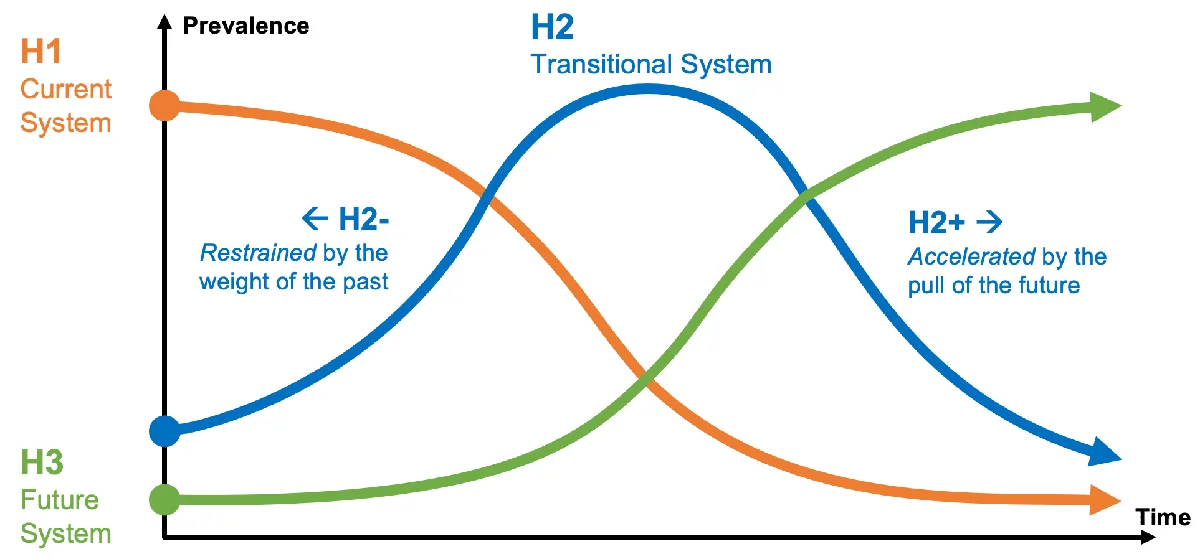
Many organizations think they're building the future when they're really just building a better version of the past. I said that last year in my Three Horizons talk, pointing out that some initiatives feel like progress but are restrained by the weight of the past. Like performance reviews moved from annually to quarterly, then called modern.
AI was supposed to be different. So far, it hasn't been.
I wrote a few weeks ago that many companies swinging on the trapeze of AI deployments have yet to let go of the bar. They have pilots, champions, and licenses, but nothing has really changed. With few exceptions, job descriptions feel the same with a few new AI bullet points.
Then Deloitte said the difficult thing out loud.
Break down the walls
The Deloitte 2026 Human Capital Trends report on modernizing corporate functions opens with a sentence I've been waiting for someone of their size to put in print:
Rather than clinging to rigid silos, [organizations] have an opportunity to deconstruct traditional corporate functions and reassemble their capabilities around human and business outcomes.
I've spent most of the past year making a version of this argument about employee experience, in which HR, IT, and real estate share a customer but rarely share a strategy. Deloitte is making the same argument about the entire corporate stack. Supply chain. Procurement. Finance operations. Legal ops. Customer service.
Every shared service is organized the same way: group similar specialists into a tower, then ask the towers to coordinate.
That structure made sense when the work was specialist-led. AI is making more and more of that work cross-functional by default, which means the boundaries between the towers are becoming the friction. I like that Deloitte calls it a deconstruction problem rather than an optimization problem.
Prepare for turf wars
In addition to the provocation, the Deloitte report also acknowledges a harsh reality:
Leaders hoping to reimagine functions must be clear-eyed about the human tendencies to protect turf and political power within an organization — regardless of what the most agile or cost-effective future structures may be.
Translation: the people with the authority to draw an H2+ organization are the same people whose careers, headcounts, budgets, and identities are tied to the current organization structure. They are the Chiefs at the top of the stacks.
Individual employees grip the old bar because they fear what AI does to their jobs. Function heads grip the old structure because they fear what deconstruction does to theirs. Same fear, sitting higher up the org chart. Even when a Chief privately agrees that the tower model is past its useful life, the move that survives the leadership meeting is the move that preserves the tower.
So we end up with H2- by default. Faster swings on the current bar are branded as a transformation.
Bring Your Leaders Across the Line
Inspired by what you're reading? Phil's talks and workshops bring a credible, cross-functional perspective to help organizations reimagine and redesign work for better experience and outcomes.
The thought experiment
The fastest way to see what H2+ looks like is to kick the Chiefs out of the room for a day.
Not permanently. Not punitively. For a workshop.
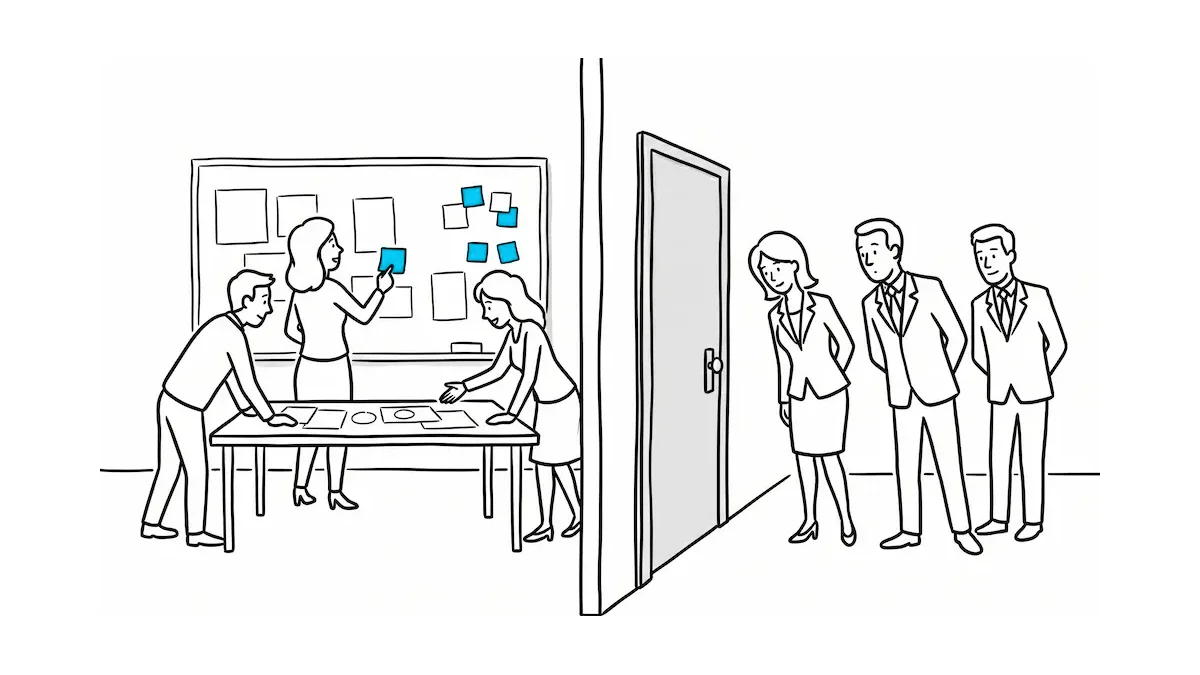
Pull every function head, and maybe their direct reports, out of the building (or virtual whiteboard). Leave the people one or two levels down. The directors and senior managers who actually do the integrated work. The ones who feel the silo seams as friction every day and have spent years quietly routing around them to get anything done.
Give that group the business strategy and ask them to put the operating model back together.
What would supply chain, customer service, procurement, finance operations, HR, IT, and real estate look like if the people designing them weren't the people running them today? Which capabilities would merge? Which would split or fail? What outcomes would the new structure orient around that the current one cannot?
Why this works
Management consulting teams often call that work a ground-up, “zero-based” organizational reimagination. The reason firms get hired to do this work, rather than the executives doing it themselves, is exactly why the Chiefs shouldn't be in the room: the people with the most authority are the ones with the most to lose, which means they're the least likely to draw the picture honestly.
You don't need a consulting firm to run the exercise, though. You need a room, a day, and permission for the people inside it to propose something the bosses might not like.
Katy George, a former McKinsey colleague of mine who now runs workforce transformation at Microsoft, said something on the WorkLab podcast last week that aligns directly with this idea: Businesses achieve sustainable results when work is genuinely redesigned, and only the people who actually do it can redesign it.
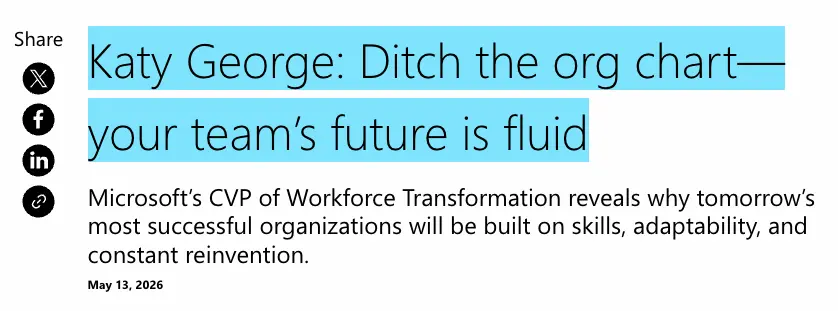
She reasons that so much of knowledge work is tacit and lives nowhere in writing. The people on the org chart above the work have too much to lose to draw the picture honestly. But we’re both pointing at the same group of people in the room.
What the room without the Chiefs will tell you
A few patterns tend to surface when you actually run this.
Capabilities cluster around outcomes, not functions. Things that belong together based on what they produce — everything required to onboard a new employee, everything required to launch a product, everything required to recover from a service failure — currently sit scattered across five or six towers. The redesign almost always pulls those threads together.
Some current functions include a lot of overhead. Specialists who could, with the right tools, work directly with each other instead sit waiting for someone to connect them. The redesign tends to shrink that coordination layer in ways that look threatening from the org chart and obvious from the work.
And the new structure will scare anyone whose job is to run a tower, which is exactly why it never gets drawn when those people are in the room.
Stop Drowning in Busywork — Lead With AI!
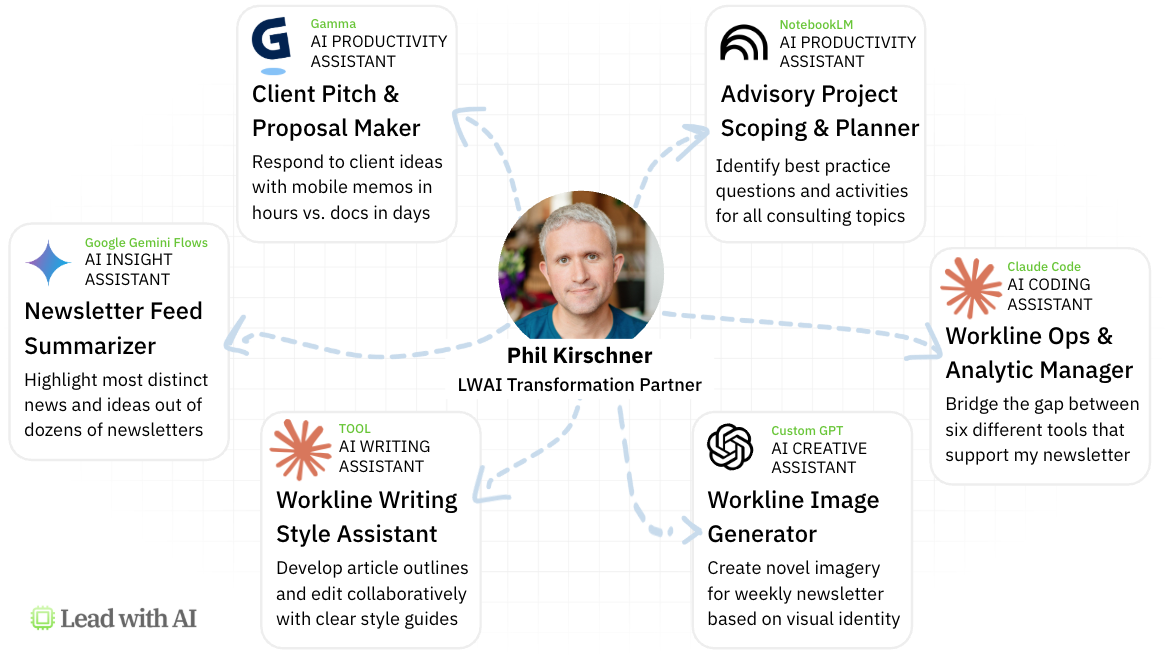
Most leaders know AI should save them time, but don’t know where to start. AI Leader Advanced is a build-as-you-learn course for which I’m a facilitator. Learn alongside peers, receive personalized coaching, and build 6 personalized AI assistants in just two weeks. Thirty minutes per day, no code required.
What can you do on Monday?
Here are three ways to find your own H2- trap and start moving toward it.
- Audit your AI conversation. Pull every AI initiative your function has run in the past six months. Count how many ask how AI helps the current work get done faster. Count how many ask whether the current work should still exist in its current form. The ratio is your H2- problem.
- Identify one silo seam that's blocking progress. Pick a single workflow or outcome that requires three or more functions to coordinate. Write down where the friction lives — where handoffs slow things down, where information gets lost, where decisions take too long. That's your starting point.
- Convene the people doing the work. Pull together the directors and senior managers (not their bosses) who live in that friction daily. Spend an hour with them asking: if you redesigned around the outcome instead of the function, what would change? Don't solve it. Just let them name what they see.
So, who goes first?
Deloitte is right that organizations will build their future structures around outcomes rather than towers. The harder thing they're saying, more quietly, is that the towers don’t like drawing their own demolition plans. The trapeze bar reaching for the future is in motion. You can keep swinging on the current one, or you can find out what your colleagues would build if you let them.
Just don't ask the Chiefs for their opinion yet.

What structural incentives in your own organization make it easier for people to optimize their current silos than to question whether those silos should exist at all? If this resonates with your work, get in touch.