

Have You Let Go Yet?
This past weekend, I attended a bar mitzvah ceremony for the twin sons of close friends. Towards the end, the rabbi turned to the two boys and asked if they knew what a liminal space was.
They did not, which I suspect is what the rabbi was counting on. She explained that liminal comes from the Latin limen, meaning threshold — the line you cross from one state into another. Judaism, like most religions, deliberately marks these threshold-crossing moments. Becoming an adult is a great example. The reason is that crossing a threshold is genuinely hard, and pretending it isn't happening makes it harder.
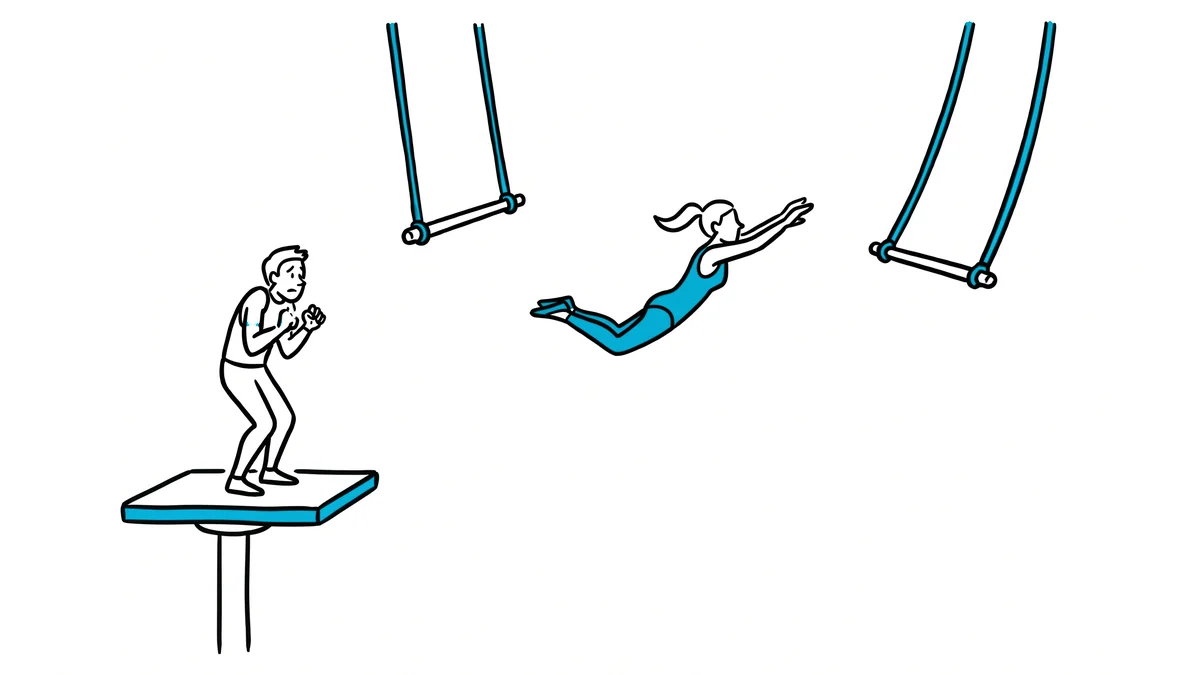
Then she reached for the parable of the trapeze.
Originated by activist Danaan Parry, a trapeze artist can be used to describe what life transitions feel like. We typically hang onto a familiar trapeze bar that swings steadily through life. Occasionally, we see an empty bar swinging toward us. To grab it, we must release the old one and hurtle through the void with no net.
Parry's central claim was that the void between bars is the only place where real change happens. Most people treat it as a no-place to be rushed through. He suggested we should give ourselves permission to hang out there.
My wife and I both loved the whole sequence. I was still ruminating on it the next morning when it finally occurred to me why the story had felt oddly familiar.
Flying Delta
I am certified in the LaMarsh Managed Change methodology, which has shaped most of my thinking about how transformations succeed or fail. LaMarsh has a name for the weightless phenomenon Parry describes. They call it the Delta State.
The Delta State is the transition itself. The space between the Current State and the Desired State, where productivity can stumble, quality can slip, customer satisfaction can wobble, and morale can nose-dive. It’s addressed while defining the change.

To give you a sense of how formally LaMarsh treats the liminal “Delta” State, here are the kinds of questions that practitioners have been trained to ask:
- What is a metric your organization uses today to evaluate performance?
- What is that figure today, and what are you hoping it will be in the future?
- How low — or high, whichever is bad — might it go during the change journey?
- What is the lowest (or highest) it could go before corrective action is required?
- Who, specifically, will be monitoring those numbers?
LaMarsh provides a “Delta Dip” assessment tool to map the gap between the smooth performance line management expects and the actual curve, which drops before it climbs back.
I have referenced LaMarsh in past articles, but have held back on this particular concept. Now feels like the right moment.
Three Acts on the Trapeze
Once you have the trapeze image in your head, it becomes a useful diagnostic for states of change, and I will use AI adoption and transformation as an example.
There are three places a person, or a company, can be during the proverbial AI circus act:
On the platform. Watching. Not piloting AI tools. Not training anyone. Not experimenting. There are real organizations here, and some of them are reading this. They are out of scope for today.
On the first bar, in motion. Piloting, training, building change agent networks, deploying ChatGPT licenses, and running prompt workshops. They feel the acceleration. They feel the fear. They feel the possibility. They have left the platform, and the swing is real. But their hands are still clenching the current state.
Hands open, in the void. They have released the old bar. They are braced for a potential productivity dip and watching the new bar swing toward them. This is the liminal Delta State proper. I believe very few traditional companies are truly here.
Most of the AI conversation right now is happening between the second and third positions, with companies in Position 2 talking like they are in Position 3.
Bring Your Leaders Across the Line
Inspired by what you're reading? Phil's talks and workshops bring a credible, cross-functional perspective to help organizations reimagine and redesign work for better experience and outcomes.
Swinging Back and Forth
Look at what many self-described "AI-forward" companies are actually doing. ChatGPT email editors. AI meeting summaries for meetings that no one redesigned. Prompt libraries shared in Slack. AI champion programs and brown-bag sessions. Six-month roadmaps with adoption KPIs. AI bolted onto the existing org chart, job descriptions, and rituals.
All of this is real activity. Hands are still on the bar, swinging back and forth.
The question I keep coming back to is, “What have you actually let go of? Not augmented. Let go. A process that no longer happens. A meeting that was retired. A role that was redefined. A measurement that was abandoned because the work it measured no longer exists in that form.
If the honest answer is nothing, the swing is on the current bar.
Why Letting Go Feels Hard
Most companies stay gripped because they sense, correctly, that the upstream work has yet to happen.
"Use AI" is a tool announcement, not a defined future state. Without naming what specifically must stop and what must start, employees default to the rational move: keep doing what they were doing, with a faster instrument. Change programs fail when leaders skip the hardest steps: defining why we have to leave the current location and articulating the destination in concrete terms.
You cannot release a bar when you do not know what bar you are reaching for, or you risk falling far and fast.
Klarna Crosses the Void
Once you are in the void, the Delta Dip is real. LaMarsh's own field guide warns that sponsors will deny the dip is happening, change agents will hide it when it shows up, and signals will get masked by noise. The work of the void is staying alert.
Klarna is the cleanest public example I have seen. In 2023, the Swedish fintech let go. They paused all hiring, partnered with OpenAI, replaced roughly 700 customer service agents with AI, dropped headcount by about 40%, and cut ties with Salesforce and Workday in favor of internal AI systems. They were truly in the air.
Then the dip arrived. Customer satisfaction declined. Complaints rose. Complex issues went unresolved. CEO Sebastian Siemiatkowski admitted that the company had "overestimated AI's capabilities and underappreciated the human aspects of service delivery."
His words: "We went too far."
In 2025, Klarna started rehiring humans. The new model is hybrid: AI handles simple inquiries, people handle nuance and empathy. The bar Klarna grabbed is a different bar than the one they originally reached for.
That is what designing the void looks like in practice.
Stop Drowning in Busywork — Lead With AI!
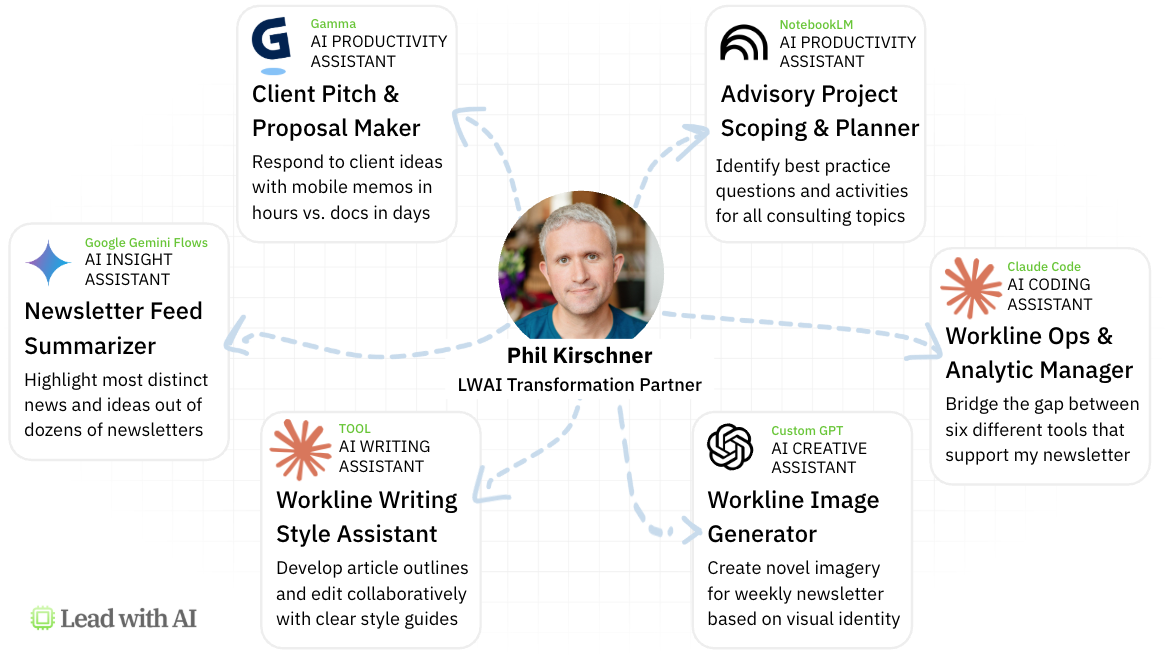
Most leaders know AI should save them time, but don’t know where to start. AI Leader Advanced is a build-as-you-learn course for which I’m a facilitator. Learn alongside peers, receive personalized coaching, and build 6 personalized AI assistants in just two weeks. Thirty minutes per day, no code required.
What Can You Do on Monday?
The bar mitzvah boys did not get to choose whether to step over the threshold into adulthood. The day arrives. The ceremony marks it.
The companies still on the platform, or still gripping the old bar, do get to choose. For now. The question is whether you’re choosing deliberately, or just hanging on out of habit.
Three things to try next week:
- Spot the new bar. Name the specific future state, not "use AI more." What process will end? What role will be redefined? If you cannot answer in concrete terms, the upstream work has not yet happened.
- Map the dip before you let go. Pick the two or three metrics that could be adversely impacted during the transition and tell your team in advance. Sponsors who deny the dip make change agents hide it, and hidden dips become the failures everyone blames on the change itself. Naming the dip changes how people interpret what they feel when it happens.
- Audit your own grip. Walk through your last week. For each AI tool you used, ask whether it replaced something or just made something faster. If everything is faster and nothing is gone, you have your answer.
Parry called the void “a no-thing, a no-place.” He also called it the only place real change ever happens. Both are true, and AI is no exception.
The leaders who learn to fly are the ones whose hands are open.

What specific threshold are you asking your team to cross, and have you made the ceremony of that crossing clear enough that they understand they cannot simply grip both bars forever? If this resonates with your work, get in touch.