
Calling All Work Product Managers
Some job postings tell you more than the job they describe. They tell you where an idea is starting to land.
I've been saying “work is a product” for a while, and it’s moving from op-ed to org chart. A recent T-Mobile posting for is one of the clearest signals I've seen yet:
The Product Manager, Employee Experience serves as a strategic leader responsible for designing, orchestrating, and continuously improving high-impact employee lifecycle experiences across T-Mobile. Every employee experience — from onboarding to growth to life events to exit — exists to support business performance, engagement, and trust. This role is accountable for identifying friction across systems, aligning technical feasibility with employee needs and business objectives, and leading cross-functional teams to deliver cohesive, scalable, and human-centered experiences.
Consider what follows an exercise in pattern recognition rather than a critique of how T-Mobile actually plans to operate; I'm reading the JD from the outside in only and have not spoken to anyone at T-Mobile about it.
T-Mobile may use different words, but I believe they're hiring a Work Product Manager, which indicates the Chief of Work is growing from the middle of the org chart.
Product Discipline, Pointed Inward
The role requires skills you'd recognize in any product organization. Roadmaps. Backlogs. Release planning. User stories. Success metrics. Rapid prototyping. The same rigor that product teams apply to customer-facing software is now being applied to how employees actually live through their company.
A few things stand out about the design.
T-Mobile names their lifecycle buckets GROW, LIVE, START. The organizing principle is what an employee experiences, not which function owns a particular system. Most companies still organize this work around the department that runs the platform: Benefits owns enrollment, IT owns provisioning, HR owns onboarding.
Naming the journeys is a quiet shift in operating logic.
The role also spans a stack that crosses functional ownership. Workday, UKG, Fidelity, Business Solver, Broadspire, ServiceNow. One person reasoning across systems owned by HR, Payroll, IT, and Benefits. That's integration work, whatever the title says.
And the success metrics are about the employee's experience of the system. Friction reduction. Time-to-resolution. Lifecycle satisfaction. Different department, same accountability logic any consumer product team would recognize.
This is the kind of role that shouldn't exist yet. The fact that it does tells us something.
The Misfits Are Multiplying
Reading the JD carefully, one phrase reminded me of nearly every job I’ve ever had:
"Influence without authority in a highly matrixed organization"
Every practitioner who has ever held a coordinating role recognizes what that language means. You own the outcome. Someone else owns the resources..
A Work Product Manager without integrative authority is a Chief of Work function compressed into a single PM role, without the mandate. They can maintain a backlog, but release planning still depends on three or four functional leaders with their own roadmaps and budgets. They can map the lifecycle, but the systems on the lifecycle map report elsewhere.
Real estate is also missing from the stakeholder list.
The lifecycle includes START (onboarding) and LIVE (life events), but the physical workplace (where most employees actually do the work) doesn't appear anywhere in the JD. An employee's experience of where they work is part of the lifecycle. It just sits with a function nobody invited to the conversation. The same systematic blind spot I've written about for years.
Influence also has its limits, as I’ve observed about frontline experience, and it applies here too. When your success depends on teams you don't manage, systems you don't own, and budgets you don't control, the ceiling on what you can deliver gets set by the next escalation, not the next sprint.
The Work Product Manager can draw the map. Someone else still has to give them the keys.
Bring Your Leaders Across the Line
Inspired by what you're reading? Phil's talks and workshops bring a credible, cross-functional perspective to help organizations reimagine and redesign work for better experience and outcomes.
Early Signal, Real Constraint
Putting product discipline against the employee lifecycle, naming the journeys, asking one person to reason across the platform stack — every one of those choices moves the work forward. I'd rather see this done imperfectly inside HR than wait for the perfect org structure to authorize it
I keep noticing roles like this, always with interesting names.
Barclays was hiring a Ways of Working Execution Coach, Dentsu an SVP of Work Design, and for my obvious favorite, Deel was seeking a Ghostbuster. (Not kidding.)
Different titles, different reporting lines. But each of these hires is a point of light, and they all point in the same direction with the same instinct.
Work itself deserves to be designed, owned, measured, and improved with the same care we'd apply to anything we ship. The employee lifecycle deserves a product owner.
What I'm watching is whether the next generation of these roles gets the cross-functional authority to match.
The Chief of Work argument doesn't require a new title at the top of the org chart. It requires someone, somewhere, with the mandate to integrate. Today, that person is more often a PM than a Chief, and the PMs are doing remarkable work under real constraints.
The question is how long the model holds before the gap between accountability and authority becomes the bottleneck.
Does This Sound Like You?
If you're in a role like this — a product manager, experience designer, journey owner, or integrator working across HR, IT, real estate, or operations to shape how work actually gets done — I want to hear from you.
Not just the people doing the job today. Also the leaders who hired one, the people who held one and moved on, and anyone who has watched the experiment work or stall from nearby.
These are the stories where the Chief of Work argument stops being abstract and starts being practical.
The JD describes the job. The people already doing it can tell us what it actually takes.
Stop Drowning in Busywork — Lead With AI!
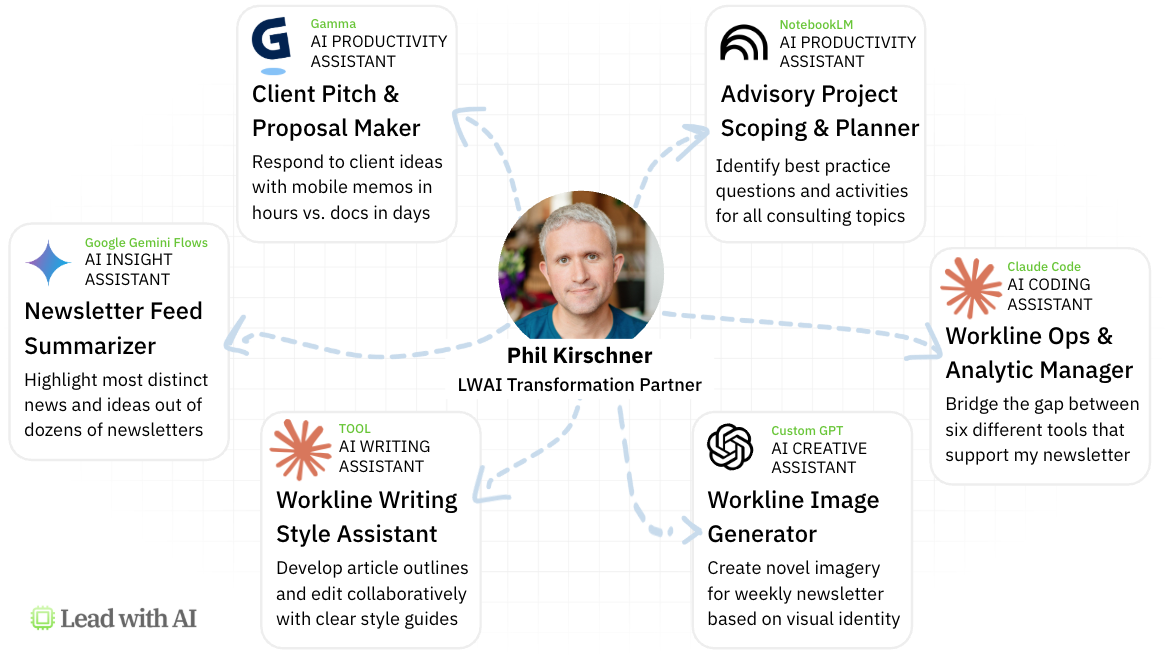
Most leaders know AI should save them time, but don’t know where to start. AI Leader Advanced is a build-as-you-learn course for which I’m a facilitator. Learn alongside peers, receive personalized coaching, and build 6 personalized AI assistants in just two weeks. Thirty minutes per day, no code required.
What Can You Do on Monday?
The gap between "we want to design work better" and "someone owns that design" is usually wider than leaders realize. Here are three places to start:
Check how your EX roadmap is governed. If there's a product plan for employee experience, who signs off on it? If the answer is three different functional leaders with veto power, you have a negotiation, not a roadmap. Write down what you find — you'll need it for the next conversation.
Bring your findings to a product leader outside HR. Find someone in your organization who ships products for customers — a head of product, a senior PM, anyone with real product discipline — and walk them through what you found. Ask whether what you're describing would qualify as a real product organization. Their answer will tell you more than any internal assessment. The gaps they name are the ones worth closing first.
Name what the authority gap costs. Every week a Work Product Manager has to escalate, persuade, or work around a functional boundary is a week of lost velocity. Start counting it. That number is your business case.
The call for change is out. Is someone in your organization picking up?

How might treating the design of work with the same rigor and ownership you apply to your customer products fundamentally change what becomes possible in your organization? If this resonates with your work, get in touch.