

Make Room for the Room
I've made a habit of attending a diverse range of conferences and sharing my observations in The Workline. My goal was initially to help break your professional filter bubbles.
I called out the placeless definition of employee experience at UNLEASH, and watched an identity struggle unfold at CoreNet ERS. I stumped a panel at Future of Work USA, challenged the narrow definition of Chief Work Officers at Charter, and crashed out at The AI Summit.
But a panel I moderated at WorkSpaces put an idea in my head that I just couldn’t shake. Then I wrote about how a modern organization handbook overlooked the office, and saw the same pattern from a different angle. I have now done the research to test my hypothesis:
The C-suite has a filter bubble problem too, and the built environment is paying the price.
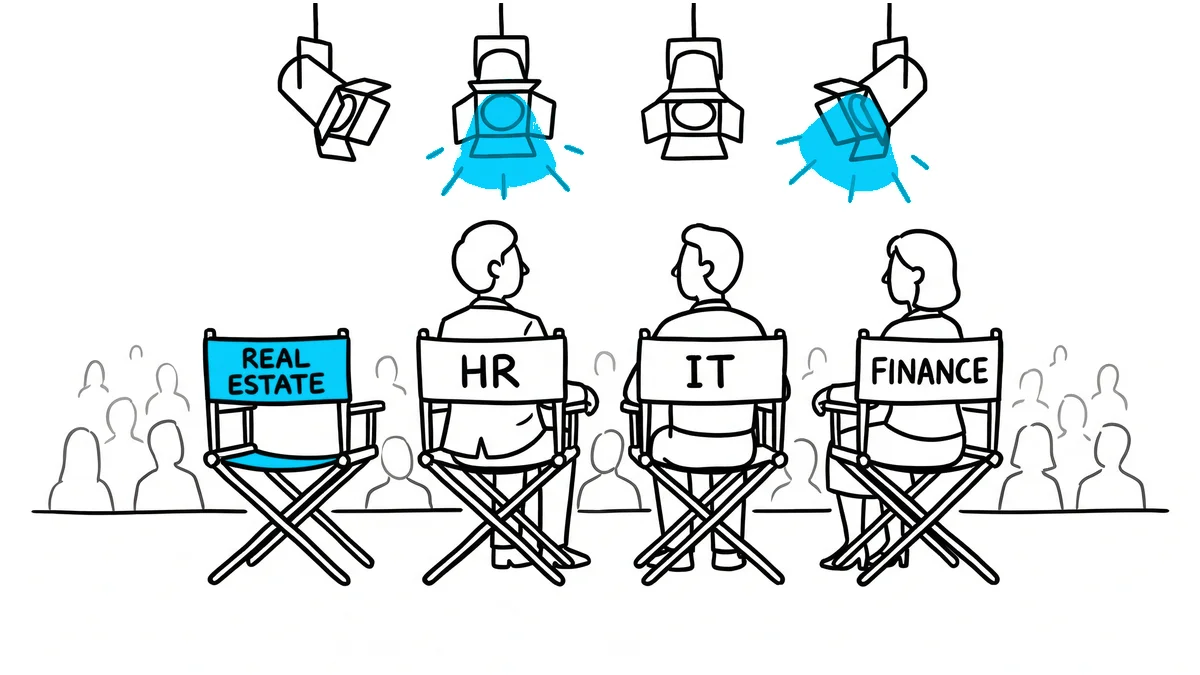
The physical workplace receives negligible airtime at flagship conferences that influence strategy and bold moves for CFOs, CHROs, and CTOs. On the flipside, those executives do not share their wisdom at conferences where real estate is center stage.
I mapped this visibility gap across the conference landscape to understand why so many workplace leaders struggle to gain strategic traction.
The executives leading HR, IT, and Finance learn in rooms where rooms are not discussed.
My Main Stage Hypothesis
To understand my full hypothesis and research, start with one fact: Corporate Real Estate (CRE) and/or Facilities Management (FM) teams do not map neatly to any one CXO ecosystem.
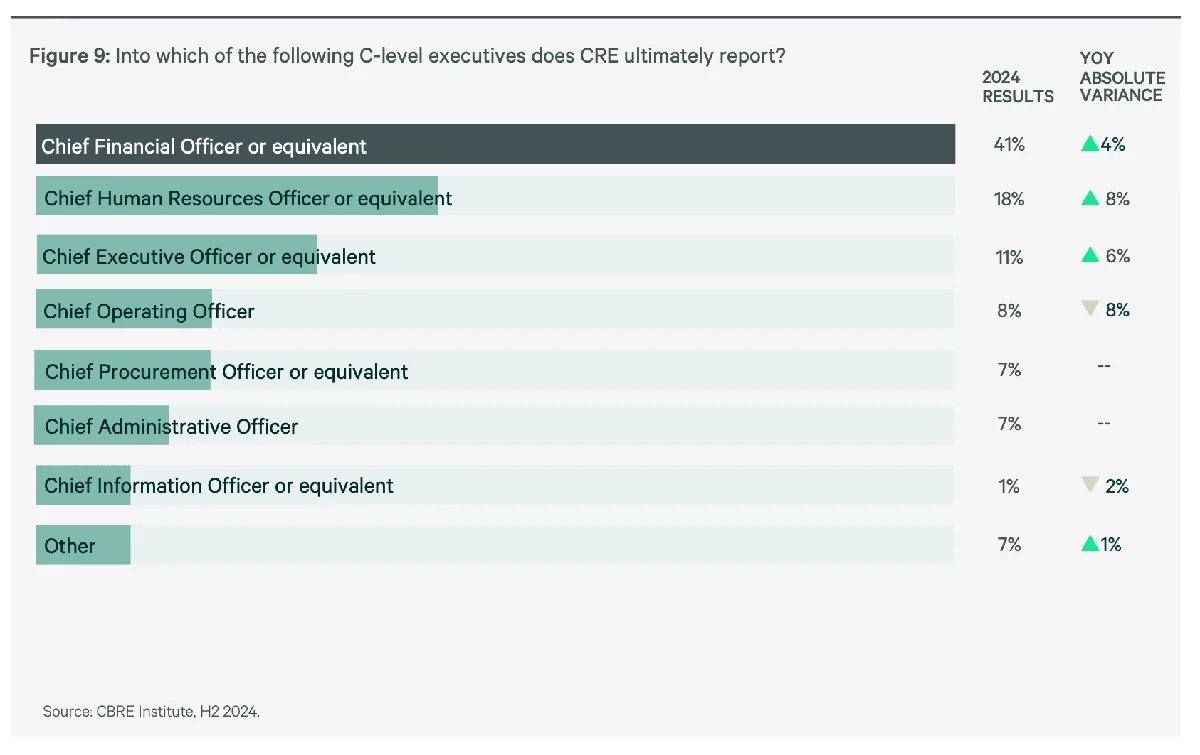
Recruiting, for example, reports to HR and never to the General Counsel. Similarly, Accounting reports to the CFO, not to the CTO. But CRE/FM leaders can report through Finance, HR, Operations, IT, or even Legal, at varying levels of depth.
I believe this organizational homelessness creates a two-part visibility gap in the conference landscape:
- At flagship CFO, CHRO, and CIO conferences, physical workplace and built environment topics rarely make the main stage.
- At major CRE and FM conferences, non-RE enterprise CXOs rarely appear in keynote, plenary, or clearly featured mainstage roles.
Furthermore, I believe that most CRE and FM leaders do not attend conferences outside the real estate ecosystem, further suppressing cross-functional narratives.
I focused my research on post-pandemic (2022 or later), flagship conferences run by industry associations, research firms, and independent media. I excluded invite-only gatherings, single-brand customer events, and the “money side” of commercial real estate and PropTech.
The head of real estate at a big box retailer may truly be an executive. Same for real estate investments at a bank. That is less true for facility leaders at companies that do not build or buy buildings as a core business.
I ran multiple AI-assisted research sessions auditing mainstage programs, then validated my findings with CRE leaders I trust. As with my Natter listening lab, the data confirmed the visibility gap, and the conversations explained why it persists.
Conference Agenda Audit
I used AI-assisted research to build a list of mainstream Finance, HR, and IT conferences, review agendas, and formalize a dataset of main stage sessions and speakers. I then validated the results with manual review and deeper checks on counterexamples.
For the CFO, CHRO, and CIO side, the sample included names like Gartner, Forbes, MIT, UNLEASH, Workhuman, etc. For CRE and FM, it’s CoreNet, IFMA, Worktech, etc.
The results against both hypotheses were stark.
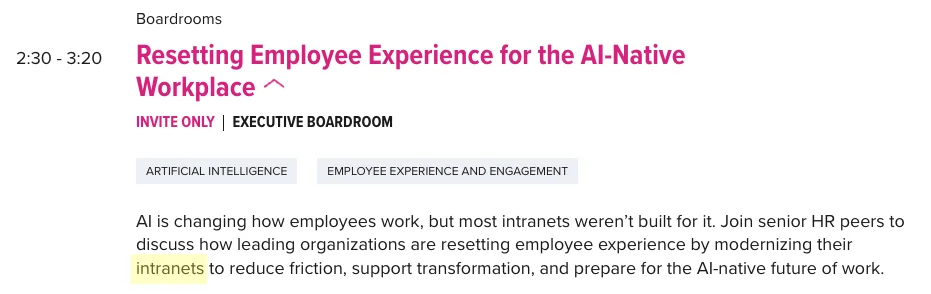
Zero keynotes or prominent stages featured physical workplace and real estate strategy for cross-functional executive audiences. There were a few near-misses, and I’ll share one interesting example.
At the upcoming Transform conference (expecting 4,000+ HR leaders), there’s a fireside chat with (construction tech company) Procore’s CHRO, but only for her general advice to other HR leaders. There’s a session called “Inside the Glass Office,” but it’s about radical transparency. Finally, the agenda once included a breakout session titled “The ROI of Space: Rethinking the Office Like a Startup,” but it was not prominently featured and has since been cancelled.
On the real estate conference side, the evidence was similarly sparse.
IFMA World Workplace opened with Daymond John — CEO and Founder of FUBU and star of Shark Tank — last year, but that's a motivational speaker. A regional FM conference had a professional sports team CIO in general session, but it was about their physical arena.

The only true counterexamples I found were the Head of SHRM speaking at the CoreNet Global Summit (in 2022, still very RTO/Hybrid-focused) and an SVP of HR from Visa on a panel at an APAC workplace summit in 2024.
These numbers confirmed CRE/FM’s organizational homelessness creates conference invisibility. The harder question was whether CRE leaders try to cross the boundary.
What Practitioners Told Me
With analytical results in hand, I emailed roughly sixty senior real estate and workplace leaders across a range of company sizes, industries, and countries. I summarized my hypotheses and asked two questions:
- Have you seen a non-RE enterprise CXO deliver a keynote or plenary at a major CRE/FM conference?
- Have you or your team attended a flagship HR, IT, or Finance conference recently?
About half responded. A handful spoke with me by phone. The first email I got opened with:
It's a phenomenal observation, one I missed until reading your message.
Nearly every response to question one confirmed the gap. A few counterexamples surfaced, but they proved to be broader EX events — often hosted by product companies — or private gatherings run by real estate developers and recruiting firms. The pattern held.
Multiple people described workplace strategy as undervalued, stuck between functions, or core to business success yet peripheral to executive attention. One leader noted a time-management reality: getting a non-CRE executive to a CRE/FM event is nearly impossible when CRE reports downstream and competes with every other strategic priority.
Question two produced more variation.
One leader tried to attend CES but faced rejection because the event was "not about real estate." Another got to attend Transform by luck when their CHRO bought a pack of tickets for the leadership team. A few said they had attended (or were about to attend) conferences for operational excellence, end-user technology, or procurement. Others were considering HR-oriented events like Workhuman, or a new crop of boutique CRE events like WorkSpaces.
But constraints still abound: limited budgets, zero attendance plans this year, or resources allocated exclusively to CRE-specific events and memberships.
The practitioners confirmed the data; the visibility gap is real, structural, and self-reinforcing.
The Cost of Conference Silos
The conference learning gap creates a downstream problem in how organizations make decisions about hybrid work, AI enablement, and employee experience.
At their respective conferences…
- HR leaders influencing RTO policies learn about culture and engagement
- Finance leaders optimizing real estate portfolios discuss cost reduction
- Technologists implementing collaboration tools learn about AI and productivity
Physical space shows up in each conversation as a constraint to manage rather than a variable to optimize. The executives leading HR, IT, and Finance learn in rooms where rooms are not discussed, then return to their organizations and make decisions accordingly.
This is the organizational structure problem I've been writing about all year, and why I believe a Chief of Work role is required. The learning ecosystems reinforce the siloed operating models, but new perspectives emerge when boundaries are crossed.
Conference organizers and professional associations could accelerate this shift. But waiting for the ecosystem to change means your competitors cross boundaries first.
Bring Your Leaders Across the Line
Inspired by what you're reading? Phil's talks and workshops bring a credible, cross-functional perspective to help organizations reimagine and redesign work for better experience and outcomes.
What Can You Do on Monday?
The organizations that will navigate the next five years of workplace transformation are building cross-functional fluency and leadership roles now, before it becomes required.
CRE and FM Leaders: Register for one mainstream HR, IT, or finance conference this year. Go as a learner, not a vendor. Notice what problems your colleagues are solving, what metrics they trust, and where the physical environment receives no attention in conversations where it belongs. Bring that intelligence back to your team.
HR, IT, and Finance Leaders: Attend a workplace conference. The practitioners managing your buildings are confronting capability gaps, data shortfalls, and strategic pressures that affect the programs you own. They feel left out of the room and need you to close that gap.
Conference Organizers and Industry Groups: Reserve one visible slot for genuine cross-functional dialogue. Make room for 'the room' in your programming.
The future of work is being written in the spaces between disciplines.
Your calendar should reflect that truth.

Are you planning to break out of your conference filter bubble this year? Get in touch to let me know what you're attending!