

Where Am I?
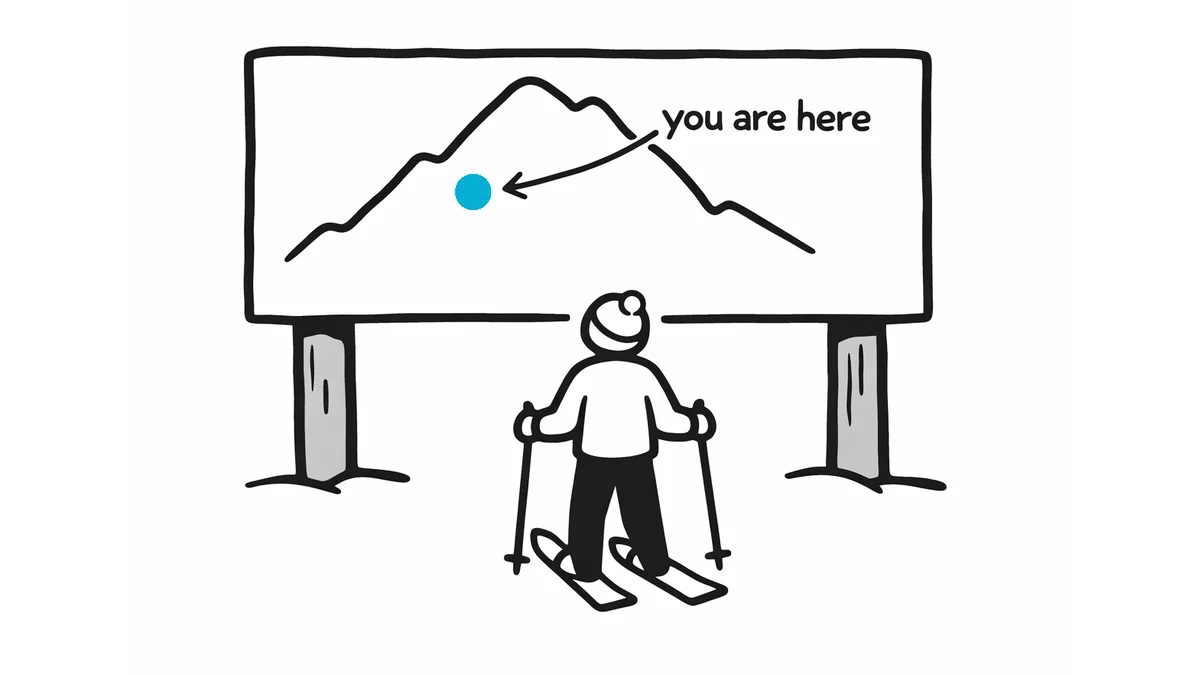
I just got back from a ski trip. One thing I love about modern skiing is the tracking app that shows me which trail I'm on, where my friends are, and how I get to après ski. The map updates constantly. Orientation is effortless.
But not so much at work.
Going from the mountain back to Monday was tough. For all the technology in the modern workplace, most employees still can't answer a surprisingly basic question:
Where am I?
Not just physically. Organizationally. Strategically. Technically.
We're good at helping people find things. We’re not great at helping them know where they are.
The Slopes Are Getting Faster
Work has become harder to navigate, and not because of bad corporate decisions. The nature of work has shifted.
Shared workspaces mean fewer fixed landmarks. Skills-based resourcing and project-based work mean your team may change frequently. Rapidly shifting priorities mean last month’s map may not match today’s terrain.
Workers cross into unfamiliar territory all the time: new floors, teams, systems, initiatives, etc. At a pace that would have been unthinkable a decade ago.
Metaphorically, we're all skiing faster. But the trail markers haven't kept up.
The result is perpetual onboarding: employees are always partially new to something, always spending cognitive energy on orientation before they can get to actual work. Every time someone joins a new project, inherits a Slack channel, or switches desks, the loop starts again.
That's expensive. And largely invisible.
The problem manifests across physical, organizational, and strategic dimensions.
Physical Wayfinding
Have you ever had to locate a meeting room with a quirky name? Great for culture, but hard to find.
I recently supported change management for a client's new HQ. Marketing created a brand-aligned naming convention for meeting rooms. In the booking system, each had an identifier such as "10E-Banana," indicating that Banana (not a real room name) was on the east side of the 10th floor. Logical enough on paper.
In practice, employees would say: "See you in Banana in 15." Blank stare. Late arrival.
Having spent years in "sit anywhere" workplace programs, I believe that room names should be self-documenting for their location, and visible inside and outside the room—especially where much of the population is mobile or transient.
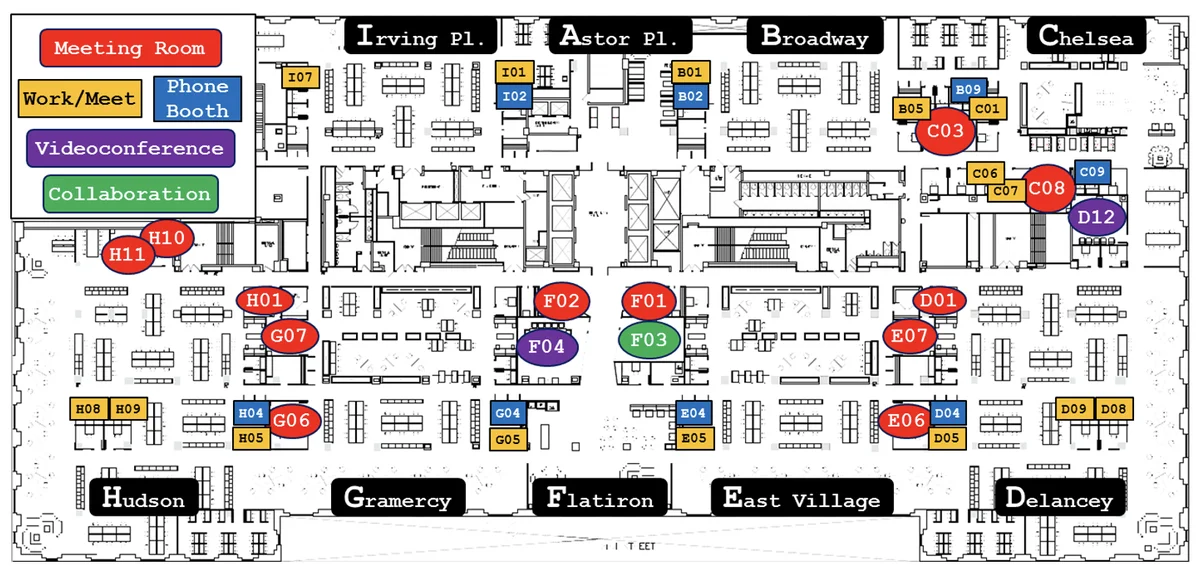
It's one reason companies like WeWork and Industrious default to something like 10A, 10B, 10C. Not inspiring, but always findable.
The frontier beyond naming is contextual: 'Find me a quiet space for three near my next meeting, available now.' That query requires a system that knows where you are, what you need, and what's around you. It's the physical equivalent of the organizational and strategic wayfinding topics below.
The cognitive load of hunting for a room is small in isolation. Multiply it by hundreds of employees navigating unfamiliar floors every week, and it adds up. It's bad enough for conference rooms. It's 10X harder with shared desks.
This is the most visible layer of the navigation problem. The next two have barely been touched.
Organizational Wayfinding
When I worked at Credit Suisse, every employee had an alphanumeric code. Much more than an employee ID number, it was structured, hierarchical, and self-documenting about one’s position in the organization. And it was visible in our emails.
So, for example, just before I left:
- T was the code for the CFO
- TL was the head of real estate
- TLF was the head of RE strategy
- TLFW was the head of workplace
- TLFW 6 was me
- TLFW 6# would have been anyone reporting to me
Email from Bob Smith (TLAB 1234)? Also in CRE and three levels deeper in the org than I was.
Email from Bob Smith (ABC)? Very senior leader; read promptly.
The system was remarkably effective, years before AI-generated notification summaries, and I’ve never seen anything like it since.
Many tools and sites use "breadcrumb" navigation to show where you are, e.g.:
Home > Women > Shoes > Boots > Rain Boots
The Credit Suisse codes were the organizational equivalent. HRIS platforms like Workday can generate org charts automatically, but knowing where others sit relative to you still takes effort.
That effort compounds as teams get more fluid. Agentic work structures, fractional contributors, cross-functional project teams: the people you work with most closely will change. When you're dropped into a project with people you've never worked with, understanding where someone sits relative to you is a precondition for working effectively together.
Strategic Wayfinding
This is the layer I think about the most.
Imagine you're new to a project. Someone sends you a document, pulls you into a Slack channel, or asks you to review a deliverable. You open it. You have no idea what it is, what initiative it belongs to, or how it connects to executive priorities. So you spend twenty minutes reverse-engineering context that should have been visible from the start.
This is exactly the kind of low-value context recovery AI should now be handling for employees.
This happens constantly, and not because people are disorganized. Most of our tools are structurally flat. Slack and Teams channels have no inherent hierarchy and names like #project-q3-surge tell you nothing. Documents are the same. You can land on a file with no idea whether it's current, who it belongs to, or where it sits in the larger body of work.
Day one at the company? Orientation and onboarding get you started. Day one on the project? Good luck.
Many companies cascade strategy through OKRs where every piece of work theoretically connects upward. That chain of context should be instantly surfaceable. In practice, it's buried in a strategy deck from last quarter that half the team hasn't read.
What if you could just ask? What is this document, this channel, this project—and why does it matter? The organizational equivalent of that clothing store breadcrumb trail.
This is where AI has potential that most organizations are leaving on the table, and it's a focus for tools like Glean and Atlassian's Rovo.
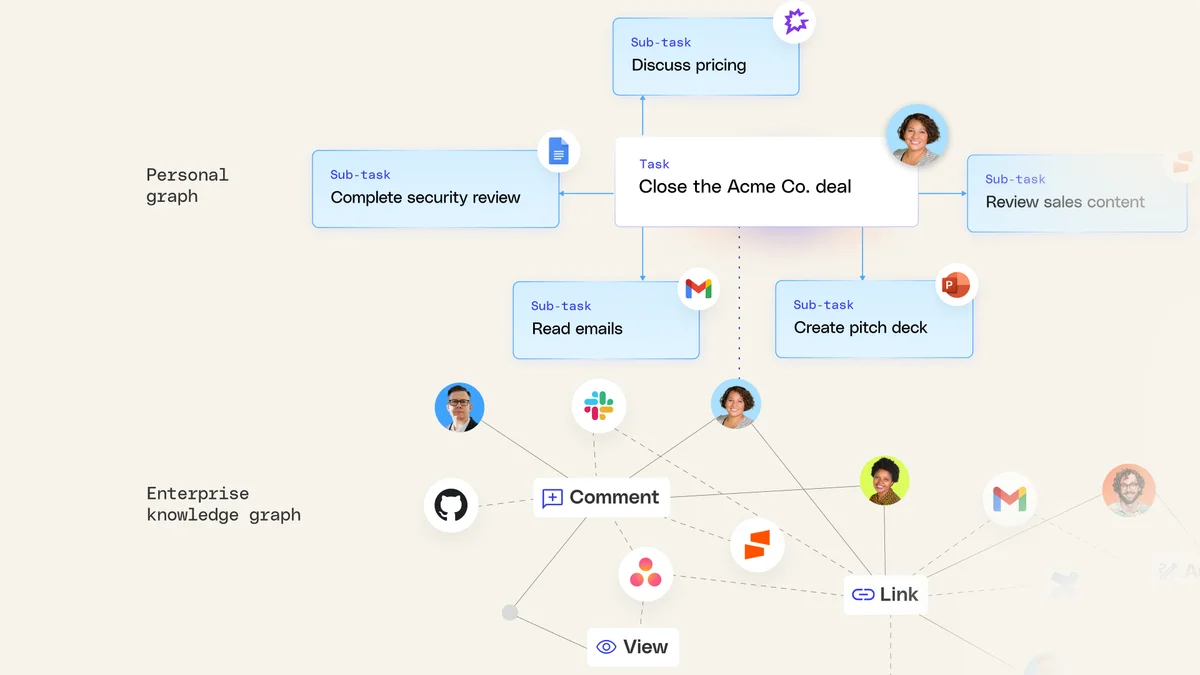
Most enterprise tools are built to help you find things. The next generation needs to help you understand where you are.
Bring Your Leaders Across the Line
Inspired by what you're reading? Phil's talks and workshops bring a credible, cross-functional perspective to help organizations reimagine and redesign work for better experience and outcomes.
The Map We Actually Need
My ski tracking app worked because it showed my current location, how trails connect, and updated conditions. You didn’t have to know the mountain.
Work needs the same across all three layers—a single orientation layer that knows where you are physically, where you sit organizationally, and where your work connects strategically. The solution is to treat orientation as infrastructure, navigability as part of employee experience, and the cost of perpetual disorientation as real.
Most organizations are stuck in the messy middle—experimenting with pieces of this without anyone owning the whole.
Physical wayfinding sits with Real Estate. Org clarity lives in HR or maybe Finance. Digital breadcrumbs come from IT. Employees experience all three as one system, even if the company manages them separately.
Nobody is looking at the company's trail map as the mountain grows and the runs get faster.
So where are you now?
My friend Brian Elliot recently cited a provocation from another friend, Samantha Gadd:
“Choose a wall and put all the initiatives that everyone’s working on up there, and then ask, ‘If we stopped doing some of these, what would employees actually notice?’”
It's a great question. It also shouldn't require a wall, a workshop, or a facilitator. A real organizational trail map would show the closed runs automatically. That's what we should be building.
Explore frictionless physical wayfinding. Room names are a start, but the ceiling is higher. One day, we’ll have presence-aware signage, mixed-reality overlays, and systems that orient you without a login or a search.
Surface org context for a fluid workforce. AI can now surface who someone is, where they sit relative to you, and what they're working on, without Workday lookups. It’s the Credit Suisse codes, rebuilt for a fluid workforce.
Retool search for orientation. Find a chatbot or search tool employees already use and ask the team that owns it: does this help people find things, or understand where they are?
The modern trail map only helps if someone owns it and builds it.

Have you seen any kind of dynamic, organizational orientation like what I've described here? Get in touch to let me know!