

How to Build a Headless Team

Two stories from the past month offer useful insights into how work is changing.
The first: Apple cannot make Mac minis fast enough. Tim Cook told investors that demand for the company’s smallest desktop has outpaced supply because developers and AI enthusiasts are buying them in volume. They want cheap, always-on machines that can run quietly in a closet, accessed remotely, doing work on their behalf. No monitor required. No keyboard attached. The computer just runs.
The second: Salesforce announced something called Headless 360. The pitch, stripped of jargon, is that customers no longer have to log into Salesforce to use Salesforce. Every capability the platform offers — data, workflows, logic — can now be accessed from wherever a person or AI agent happens to be working.
Two announcements pointing the same direction. People want to consume work products and services on their own terms and times.
What headless actually means
If you’re like me, the term “headless” evokes ghoulish memories of Halloween and The Legend of Sleepy Hollow. I promise that the technical definition is much more friendly.
In computing, a headless system is one you can use without sitting in front of it. No screen. No mouse. No requirement that someone be present at the machine for the machine to do its job. For a digital service, it means you can learn about it, ask questions, and receive structured answers without having to go to its website, so to speak.
The capability remains; the interface (the “head”) is just no longer required for access.
Translate that to how a team or a leader operates and you get a useful provocation. A team running headless is one whose capabilities, decisions, data, and outputs can be accessed without scheduling a meeting, sending a distracting Slack message, or picking up the phone. The work is available. The terms of access are clear. The dependence on synchronous presence has been engineered out.
That sounds threatening to a lot of leaders. It shouldn’t.
What an API is, in plain English
The word API gets thrown around constantly in technology circles and is rarely explained to the people who most need to understand it.
Directly related to the concept of running something headless, an Application Programming Interface is essentially a contract. It says: here is what I do, here is how to ask for it, and here is what you can expect back. When two software systems interact through an API, neither has to know the other’s internal workings. They just have to honor the terms of the contract.
Now apply that to a human team.
What would it mean to operate as a contract rather than as a personality? To publish, in some accessible form, what your team does, what inputs you need, what outputs others can expect, and how to engage you for what? That is what running like an API looks like for an organization. Standardization is liberation, because nobody has to negotiate the terms of access every single time.
Stop Drowning in Busywork — Lead With AI!
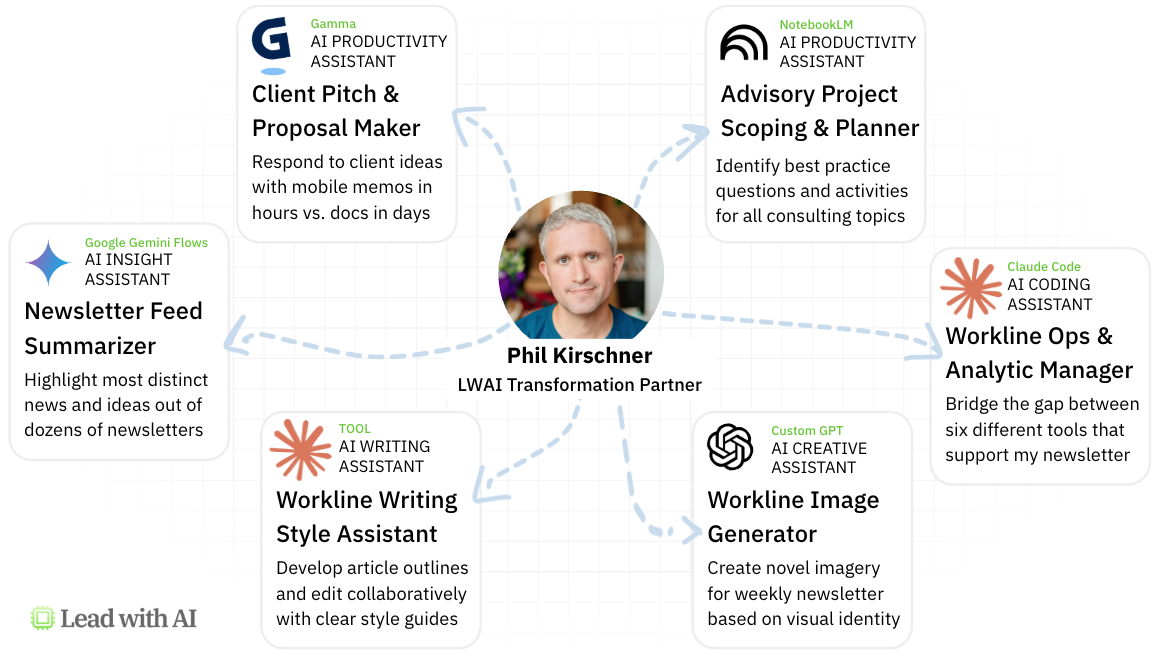
Most leaders know AI should save them time, but don’t know where to start. AI Leader Advanced is a build-as-you-learn course for which I’m a facilitator. Learn alongside peers, receive personalized coaching, and build 6 personalized AI assistants in just two weeks. Thirty minutes per day, no code required.
Control shifts to the consumer
When you run headless and offer API-style access to your work, you are giving your service consumers real flexibility. They decide when to engage, in what format, at what depth, through which system. They are no longer captive to your office hours or your preferred meeting cadence. Your team’s lights being off no longer means your team’s value is unavailable.
That is a profoundly distributed-friendly stance, and it’s why remote-first companies are so obsessed with playbook and documentation culture. It says: my value is not in gatekeeping access to me. My value is in having something worth accessing.
If this idea makes you feel uncomfortable as a leader, keep in mind that it’s not too different from the support model surrounding our most senior executives, who have always been protected by an access layer. Executive assistants. Chiefs of staff. Inboxes triaged by someone else. Calendar holds enforced by someone else. Briefing documents prepared in advance so that the live conversation, when it happens, is high-leverage.

While not an API in the technical sense, this boundary layer allows executives to protect their time, and maximize their impact, while still giving the organization access to their capabilities.
What is changing now is that everyone else gets to operate this way.
Scaling to the organization
Imagine a coordinated employee experience capability that aggregates signals from HR, IT, and real estate into one place. A team manager could query it on her own time: are my team's working patterns and tool choices optimal? Where is the best place to host an offsite, and how should we facilitate it? Answers come back without an internal consult.
The EX function offering that service sees, in aggregate, what every team is asking. They spot patterns no individual team could see, and they come out from behind the API to coach the teams who would benefit most and design systemic improvements that lift many at once.
The headless layer makes the human layer smarter and more valuable, not smaller. That is the paradox of running this way. Stripping out the routine, the documented, and the answerable does not make you less essential. It makes the time you do spend in live conversation more so, because you have stopped being the bottleneck for things that should never have required one.
The headless leader is the one whose value travels beyond a single calendar.
Bring Your Leaders Across the Line
Inspired by what you're reading? Phil's talks and workshops bring a credible, cross-functional perspective to help organizations reimagine and redesign work for better experience and outcomes.
What can you do on Monday?
I maintain a "headless" operation by making my views publicly accessible through The Workline, LinkedIn, and 30+ podcasts. When people request “informal chats,” I ask that they first consume this existing content. It’s a redirection to ensure synchronous time is high-leverage.
You do not need a platform or a budget to start running this way. You need a decision to make your work legible to people who are not in the room with you.
Write a team agreement that faces outward. Team agreements are a popular recommendation for improving hybrid coordination issues, but they usually stop at a team's edge. Write the version everyone else in the organization can read. What does your team do? What can others ask of you, and how? What inputs do you need? This is your API.
Send the artifact before the meeting. eject the next meeting request to learn something about you or how to work with you. Send something already documented, recorded, or published, and offer to talk after they have read it. Not a deflection. A redirection. You are protecting the live conversation for the part that needs both of you concurrently.
Audit one recurring meeting against your published self. Pick a meeting where you are the gatekeeper. Ask honestly whether the live conversation could be done asynchronously through what you have already shared. If the answer is no, cancel it or shorten it. Reclaim the time for your most valuable work.
The headless team is not the absent team. It is the team whose value does not depend on anyone being in the room.

What one piece of your work or expertise could you make publicly accessible this week so that others can understand your value without needing direct access to you? If this resonates with your work, get in touch.