

Everything You Leave Before You Leave
I have a habit of reading job postings too closely. Especially the ones that stand out.
Last year it was a T-Mobile role that treated the employee lifecycle like a product. This month it's Barclays, who are hiring a "Change Lead - Leaving the Bank."
The role sits in HR — specifically in Colleague Experience — relies on product management discipline, and owns the change portfolio for a single journey.
What happens when someone goes?
The stock image atop the careers page features a smiling young woman. I found a LinkedIn post from a year ago, seemingly for the same role, with a photograph of three people on a set of wooden steps, mid-conversation, all of them smiling.

Nobody in either photo looked like they were going anywhere. And that got me thinking about how often we leave something at work other than the job.
Client vs. Colleague Confusion
I learned about the role when a UK-based behavioral scientist shared it on LinkedIn with real enthusiasm. "Wow. Wow. Wow. This role is so good!!" was the top line of his post. It drew nearly 600 reactions and several reposts, but the comments went sideways.
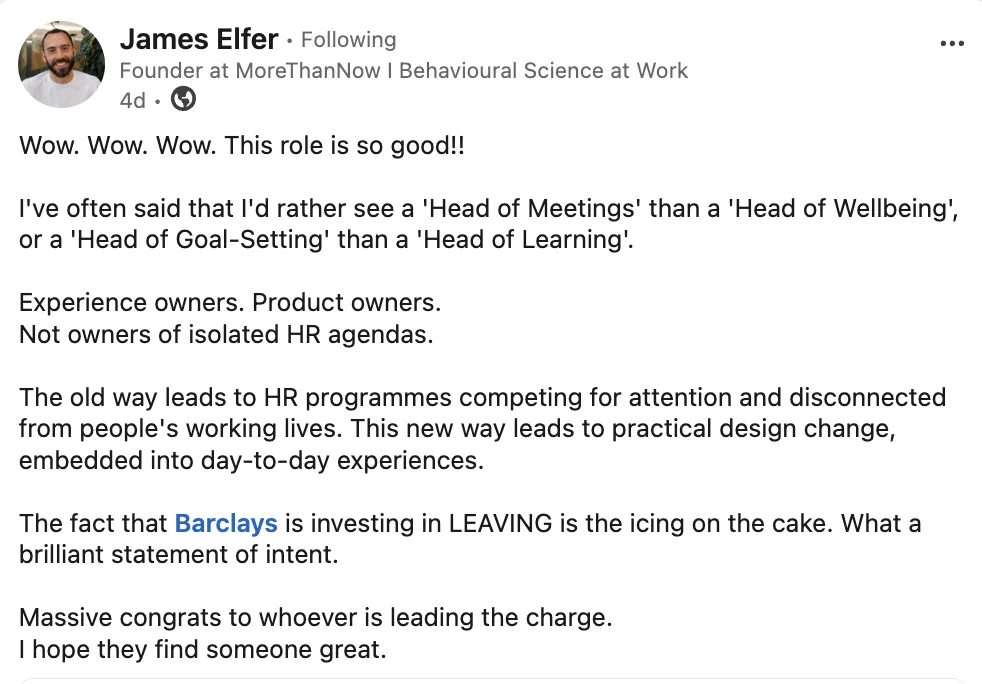
A talent leader asked, in public, whether the role was about clients leaving the bank instead of employees. The man who shared it replied that on a second read he was no longer certain, so he confirmed it with an insider. A data platform architect called it the strangest job ad she had seen in a while, and guessed the bank was applying a customer churn model to its own staff.
The JD is, undoubtedly, confusing.
In the more human-sounding paragraphs, "colleague" appears three times and "client" never. In the templated accountabilities below, "colleague" appears once and "client" twelve times, alongside client-centric strategies and the bank's product offerings. One instance is misspelled "clientr," which tells you how many people read that far.
I'm sure Barclays had a mature job family for client experience and product management, and no ready equivalent for colleague experience, so a colleague journey JD sounds like fixing customer churn.
I have argued for a while now that work is a product. Barclays proved it by accident, using the only available product architecture.
Right Event, Wrong Size
For a day or so, the comments poured in about which population the role served. Everyone arguing, on both sides, shared the single assumption that leaving means exiting the company.
The posting asks for four core skills:
1. Workday and ServiceNow experience in "the leaving space"
2. Product ownership
3. Digital transformation
4. Agile delivery qualifications
Empathy appears nowhere. Neither do exit interviews. Nor does any acknowledgment that much of leaving happens to people who never chose it, through redundancy, ill health, misconduct, or bereavement.
An organizational development practitioner in the comments said what several people were circling — the bank asks for digital skills where the work calls for human ones. The posting is graded Vice President, which at a UK bank sits below Director and Managing Director. A mid-level delivery job, several rungs beneath where an operating model gets designed.
The bank is saying "own a journey," but it sounds much more like "make it easier to log terminations."
Not the same.
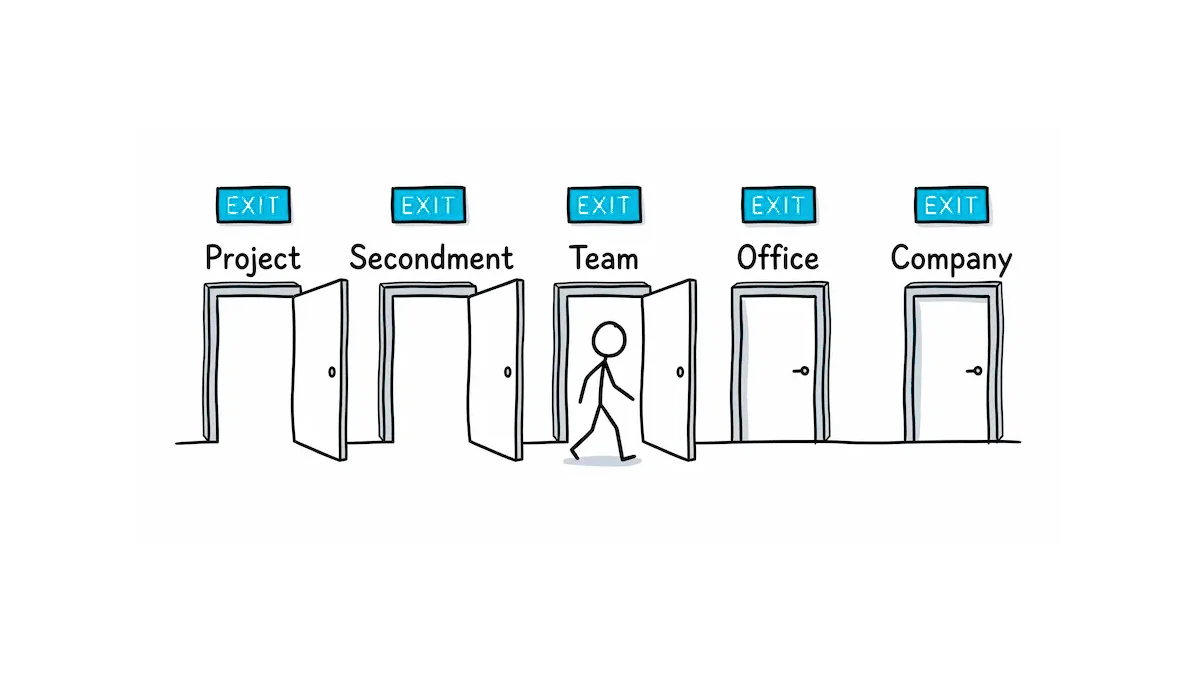
Everything You Leave Before You Leave
Count how many times you have left something at work without leaving the company.
A project ships and the team dissolves, taking its context with it. A secondment, rotation, or international assignment ends. A reorg triggers a new manager. Your assigned desk changes. A floor closes. A contract expires.
And yes, a few times in a career, you leave the company.
Barclays named that last one: the rarest of the set, the loudest, and the only one with a Workday record behind it. The others have owners in name only, like IT closing accounts, security taking back badges, corporate real estate reclaiming your desk, or Mobility repatriating your family.
I bet none of these other functions consider their role part of a broader "leaving" journey.
Then there is the population every commenter missed.
The HRIS is typically blind to contractors, agency staff, and anyone whose ending is governed by a vendor system. That post I found from last year was published by a recruiter working the Barclays account through an outsourced staffing provider. The leaving journey she advertised would almost certainly not have covered her own.
Place gets skipped most reliably. When a lease runs out, nobody marks the end of a building they visited twice a month. Who manages the loss of a place that held a significant part of your working life?
Change programs celebrate the new location and forget the one left behind.
Why Design the Ending
Capturing what someone knows before they go has been nobody's job for thirty years. People leaving on good terms write a handover document that rarely clears the bar for real knowledge transfer. People asked to leave, or rushing for the door, may just say "good luck."
But it's getting easier to capture this knowledge without depending on the departing employee's mood.
AI can hold the context that used to walk out the door, which turns an ending into something you can design. I made an adjacent argument about coordination overhead earlier this year, and endings pay back faster, because the current alternative is total loss.
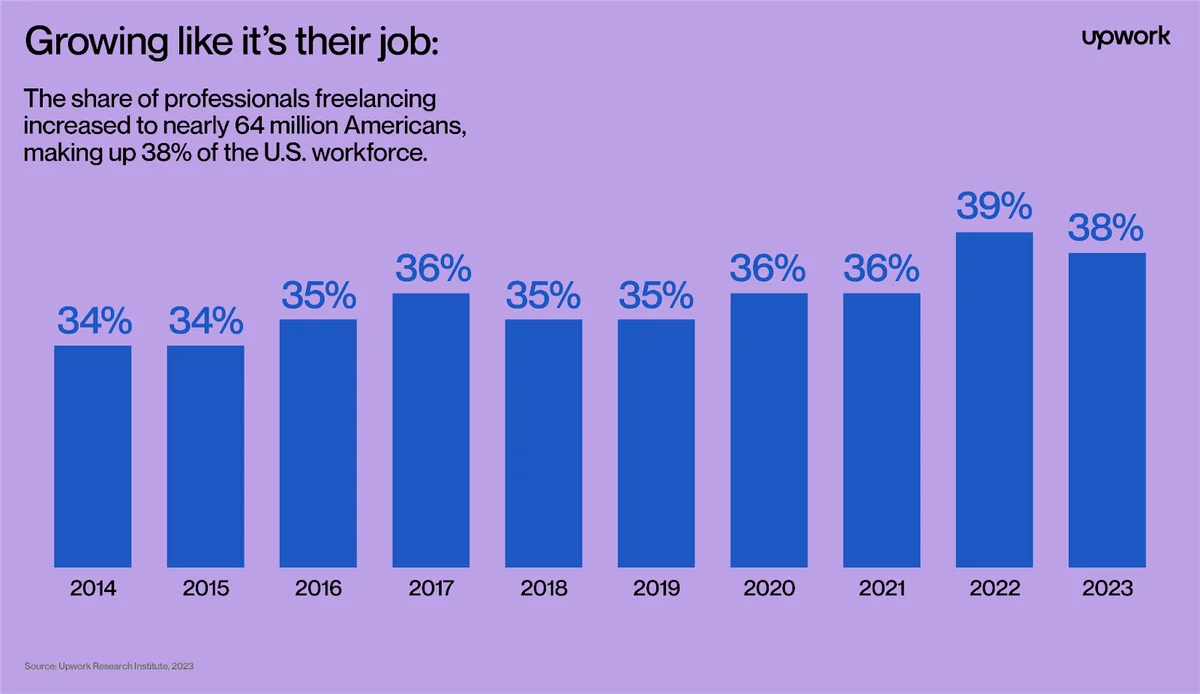
Tenure also keeps shortening while contingent and gig work keep growing. Leaving is becoming something that happens on a rhythm.
A properly scoped version of this role would own every ending on that list. The signals that predict a leaver, knowledge that walks out, access and assets that come back, the relationship afterward, etc. One backlog, one owner, one set of outcome numbers. This is the whole Chief of Work case, sitting inside one journey. A single function integrating people, the human-centered layer of technology, and place around the days employees actually live through, holding the outcome data that shows whether any of it worked.
Two commenters read the posting more darkly. One suggested that a bank investing in leaving during an automation wave may be smoothing the exit rather than fixing the reasons people leave. Another wrote that it reads like a plan to offboard people faster.
The job description supports them. It promises experience, effectiveness, efficiency, and control, and three of those four are operational. Whoever takes this job either reports on why people leave or only on how fast they are processed.
The word alumni also appears nowhere in the posting.
I spent three years at McKinsey, where leaving is the expected outcome and the firm is built for it. A searchable directory. Events. Learning that continues after you go. A job board that outside recruiters use to hire its former consultants. The firm helps other companies hire the people it trained, and profits from that for decades.
Count how many of your leavers come back; that number prices the whole experience.
What Can You Do on Monday?
All organizations face a higher velocity of micro-exits, and would be wise to focus on offboarding as much as onboarding.
Three steps to keep loving leaving next week:
Count the leavings nobody logs. Take one quarter and list every project that ended, secondment that closed, squad that dissolved, and desk that got handed back. Mark the ones that produced a real handover. The unmarked rows are your backlog.
Rehearse one ending you can see coming. Pick something finishing in the next 90 days and decide in advance what gets captured, who receives it, and what comes back. A single rehearsal will teach you more than a policy.
Decide what happens to their AI history. Someone leaves on Friday and IT closes the account on Monday, taking every prompt, thread, and half-finished analysis with it. Find out who made that call at your company, and whether anyone weighed the knowledge against the privacy rules before the account closed.

The photograph on last year's version of this posting shows three people talking on a set of steps, and all three of them still work there.
Design the day one of them walks.

If everyone who left your team this year had handed over what they knew, what would your organization be able to do next week that it cannot do today? If this resonates with your work, get in touch.