

Orchestration Overload
I rarely build an article around recent headlines or another newsletter, but Charter's last round-up included a line that caught my eye:
"'Orchestration' is becoming the new buzzword organizations are using for the skill workers need to get the most from AI."
Three links followed: a Financial Times article, new research from KPMG and the U. of Texas, and an Adecco Group report naming "hybrid work orchestration" as the model for the next decade.
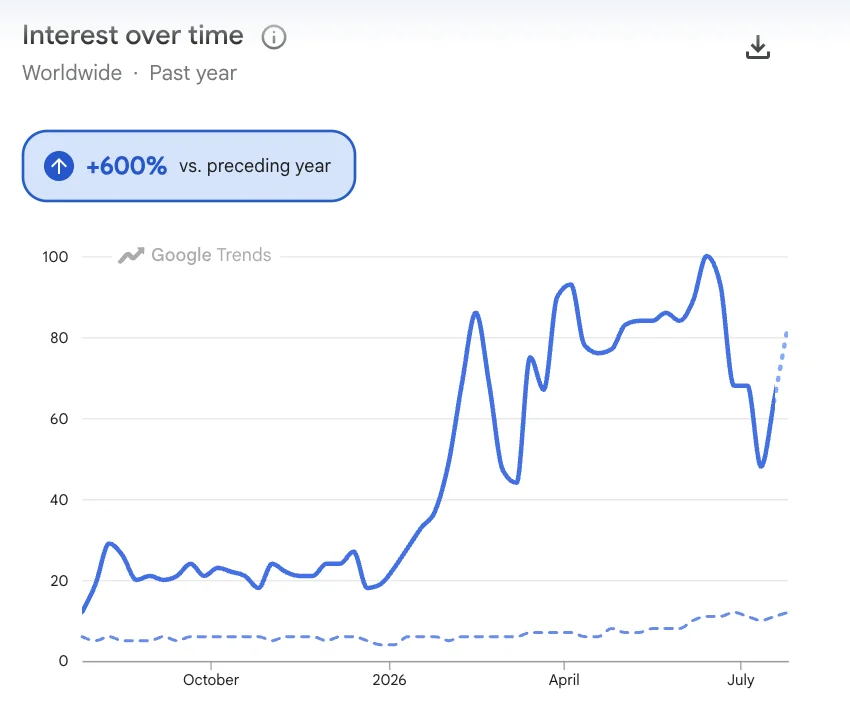
Three examples do not make a "buzzword," but worldwide Google search interest in "orchestration" is up 600% year-over-year.
So I read all three sources, which describe three different things.
And it put me down a management theory rabbit hole.
The Podium Problem
The word "orchestration" has some business baggage.
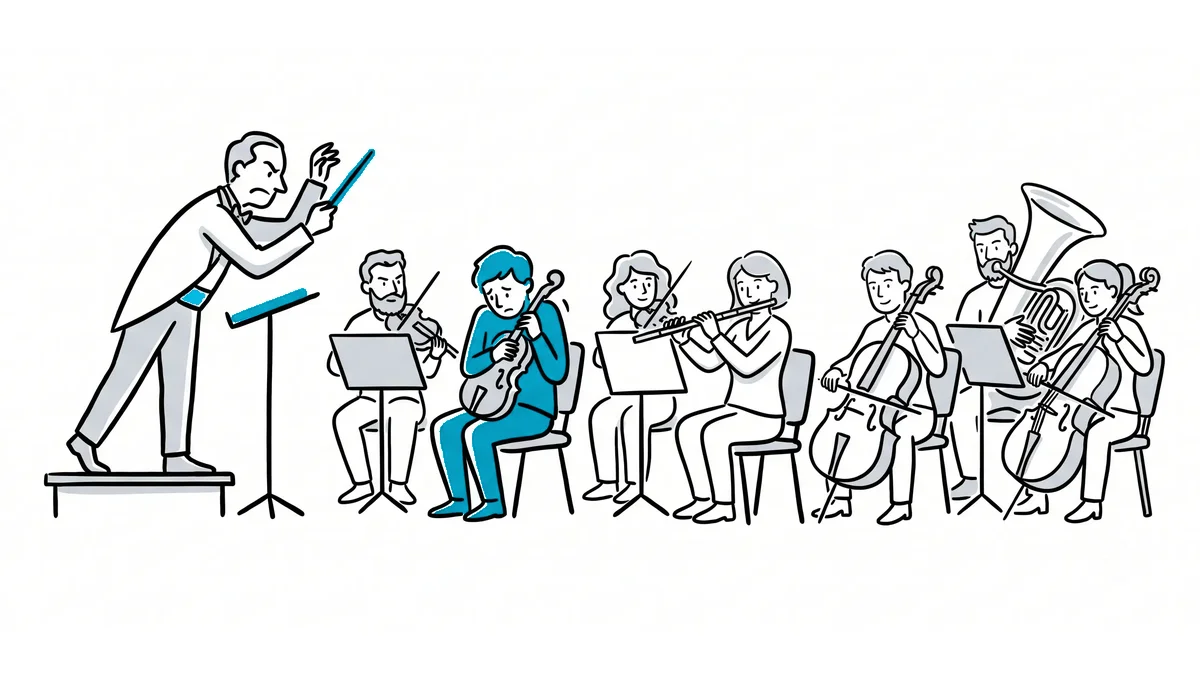
Peter Drucker compared organizations to orchestras in a 1988 HBR essay: a business with "but a single conductor-CEO," where every musician "plays directly to that person without any [middle-management] intermediaries." It was a flattering picture of a flat company, but the metaphor carries three assumptions:
- Someone holds authority on a podium.
- A score exists, written before anyone shows up.
- The players have rehearsed their parts and will perform them as written.
Modern work supplies none of the above.
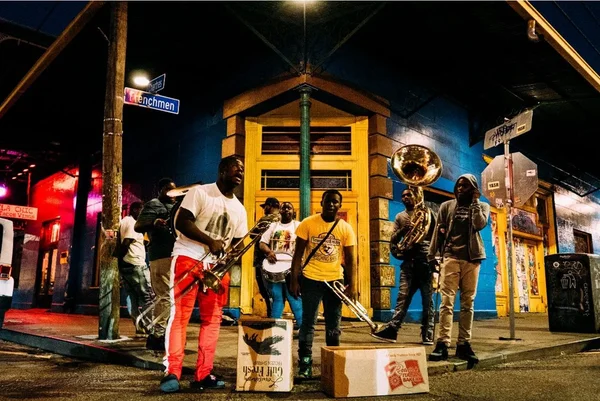
BCG first objected in 1990: "no one gives a CEO the music he should play." Warren Bennis said, "I used to think that running an organization was equivalent to conducting a symphony orchestra. But I don't think that's quite it; it's more like jazz."
I did not know that history when I used the image below in my "Connectivity-Based Workplace" keynotes a few years ago, likening the future of work to a scrappy jazz band.
I have also used orchestration approvingly. In Return on Connection, I described "that mindset shift from ownership to orchestration."
What changed this year is the volume.
You Keep Using That Word
Four groups are selling four definitions to four different people inside your building.
IT hears infrastructure. Anthropic's orchestrator-worker pattern: a lead agent decomposes a task, routes the pieces to sub-agents, and reassembles the result.
L&D hears a personal skill. KPMG and the U. of Texas sorted 523 early-career professionals into apprentices, delegators, and amplifiers. The ones who pulled ahead scored no higher on domain knowledge; what separated them was how they worked with the tool, the same argument I made about AI fluency a few weeks ago.
HR hears a labor model. Adecco calls hybrid workforce orchestration "the discipline of redesigning work so people, AI agents, automation and physical AI each contribute." That is the world's largest staffing firm, whose CEO calls the category "exactly our mission."
The CIO hears a job title. Deloitte surveyed more than 660 technology executives and titled the finding "from operators to orchestrators." ServiceNow brands the AI orchestrator as 2026's job of the year.
Ask who is conducting, and four hands go up with four different answers.
It's like every function is nodding along at a silent disco, listening to different songs.
Practice, Practice, Practice
You know the old joke about how one gets to Carnegie Hall?
I have no musical ability of my own, just a habit of chasing metaphors. So I went looking for musical organizations that tried what the word implies: an orchestra with nobody on the podium. They exist.
Moscow, 1922. A violinist named Lev Tseitlin founded the first symphony ensemble without a conductor. Up to 150 musicians sat in a circle so they could see one another. Every player learned the entire score. Decisions went to committee. The model was widely copied.
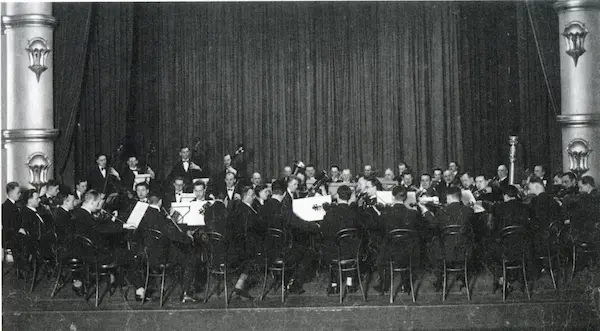
Then I found a fascinating number. In 1928, the critic Leonid Sabaneev observed that the ensemble needed 20 rehearsals to produce a well-blended performance of a program the players already knew.
Twenty rehearsals, for familiar music. That is what removing the podium costs.
For jazz, I assumed improvisation meant fewer rules. But Charles Limb put six professional pianists in an fMRI scanner and found that improvising switched off the brain region handling self-monitoring. They could stop watching themselves because the material was over-learned past the point of needing it.
Freedom to improvise gets paid for in advance.
Steady Rhythms
A jazz band holds together because the rhythm section keeps a baseline, and that baseline is what frees everyone else to leave it.
I drew this distinction in Take Your Pulse: cadence provides structure, rhythm creates feeling, and the strongest organizations run both at once.
In a company, that baseline must be written down. Documented ways of working. Clear rules for meetings. Shared understanding of which tool does what. GitLab's public handbook runs past 2,000 pages so a fully remote workforce can act without asking permission. The improvisation is the individual choice of what, when, and where.
Most organizations asking their people to be agile have skipped this baseline.
AI hands time back and almost nobody designs where the hours go. Orchestration talk has the same shape. Buy the platform, name the role, announce the discipline, and leave the shared context behind.
Wrong Notes
Even with the baseline in place, the performance breaks. The buzzword has nothing to say about that part.
Herbie Hancock tells a story about a night with Miles Davis. Mid-solo, Hancock played an errant chord. Miles paused, then played a run of notes that made the chord sound intentional.
"Miles didn't hear it as a mistake. He heard it as something that happened. As an event... he thought it was his responsibility to find something that fit."
Hancock was rattled, but the audience heard a great performance.
Your organization will hit wrong notes. What the audience remembers is the note that comes next.
Shining Eyes
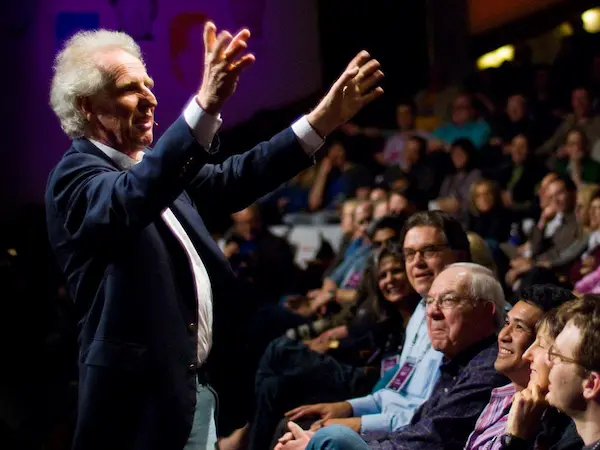
Benjamin Zander founded the Boston Philharmonic in 1979 and will conduct its final season next year. Nobody has better standing to defend the podium. He describes it this way:
"The conductor of an orchestra doesn't make a sound... He depends, for his power, on his ability to make other people powerful."
I've quoted Zander in versions of my Three Horizons talk. He measures his success by his players' eyes. When they go dull, he asks one question: "Who am I being that my players' eyes are not shining?"
Plenty of organizations want the baton.
Very few want that question.
What Can You Conduct on Monday?
A 600% buzzword curve carries its own momentum, but what you control is what orchestration means inside your own walls.
Here are three ways to wave the baton next week:
- Make vendors pick a lane. At your next AI briefing, ask which of the four they are selling: infrastructure, personal skill, labor model, or job title. Make sure your team in the room is cross-functional to catch variations.
- Tally your skipped rehearsals. Take one team you have told to move faster and check what exists in writing: how decisions get made, how urgency gets signaled, where the work lives. Every gap is a rehearsal somebody still has to pay for.
- Rehearse the recovery. Take the last thing that broke in front of customers and ask who found the next note. If everyone stopped and waited for a decision, you have located your real gap.
Just remember that the podium makes no sound.
Whatever you call the orchestrator role, the music comes from everybody else.

The next time your organization plays a wrong note in public, who will find the note that follows it, and will the rest of the room follow them or stop? If this resonates with your work, get in touch.