

The Lines Were Already Moving
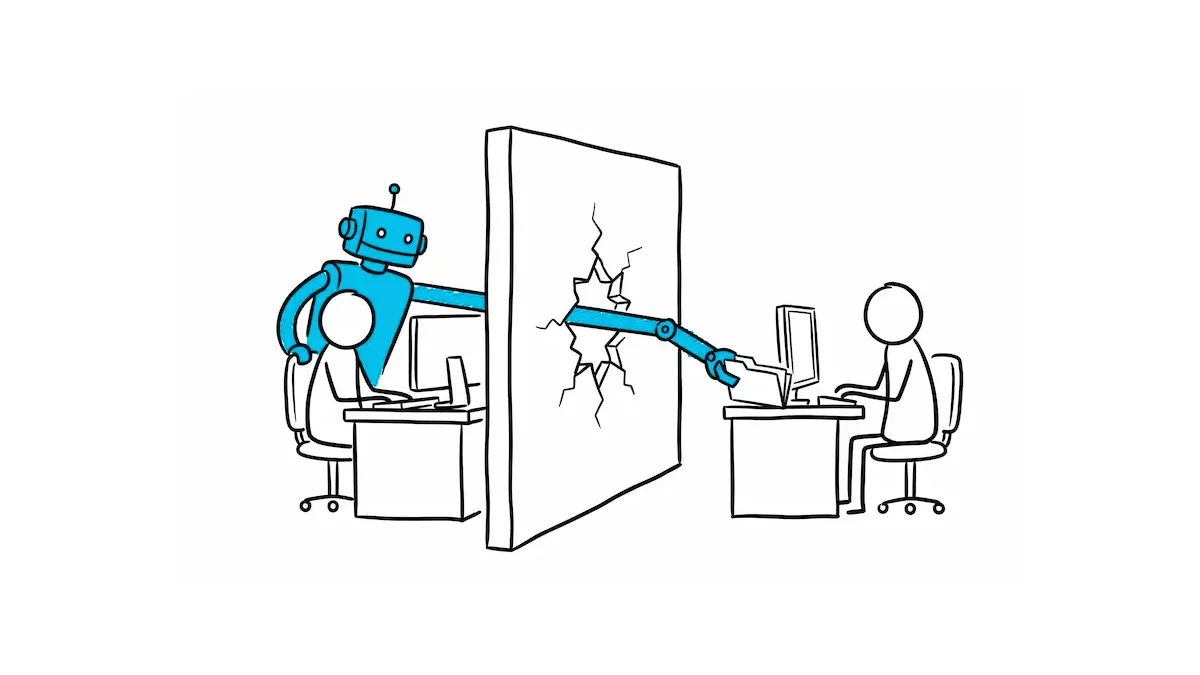
After you submit a request at work — e.g., tech support, an expense approval, a policy update — have you ever wanted to reach your own hand through the system to check on it? Or felt like you could just do the thing yourself if you had the access and knew how?
My slogan for The Workline is "lead across the lines of modern work," and I spend most of my time writing about the problems that traditional silos and mismatched incentives create. A line in Rishad Tobaccowala's newsletter, six weeks ago now, said the same thing better:
"AI is like hydrochloric acid that burns through all the containers of the past. Different areas and tasks leak into each other while others evaporate away."
Great line, though it skips where all that pressure came from in the first place.
People have been trying to reach across those barriers for a while, quietly, to move faster and skip the friction. The pressure's been building like water behind a dam. Agentic systems found a way through the concrete, and now employees are reaching straight through the holes, doing work that used to sit outside their reach.
Later in the same piece, Tobaccowala wrote that "a job is a container of responsibilities which may no longer be fit for purpose." I agree with the sentiment.
Two new reports, from Perplexity and OpenAI, have put numbers behind this provocation.
Previous Points of Pressure
I've watched people push at this wall for years, no AI required.
Lynn Rogers, then BMO's Chief Employee Experience Officer, pushed through her own HR colleagues' resistance to run a workplace-experience survey that fell outside what the annual engagement survey was built to ask.
Michael Powers, who runs comms and workplace at Klaviyo, asked his IT colleagues so many questions about tool usage data that they just added him to the admin group for Slack, Zoom, and Google Workspace instead of fielding another request.
Engineers at a company I have sworn to keep a secret were hacking their own office software and hardware: a script that auto-books a favorite desk at 12:01am, a data cable pulled from a lighting system to route network access to a side project. Each idea found the gap and went through it, organizational silos be damned.
Each one led across a line nobody drew for them.
New Numbers Breaking Through
Two recent reports back this up: AI agents piercing organizational boundaries, or in Rishad's words, chemically burning through them.
OpenAI studied more than 800,000 ChatGPT messages from U.S. users and found that 43.5% of occupation-specific use is for work that technically belongs to someone else's job, 77% of it for customer experience workers, 75% for designers, 69% for HR, with financial calculation and tech troubleshooting the most commonly borrowed tasks across the board, all without a call center representative in sight.

Researchers embedded at Perplexity published a companion study in Harvard Business Review, comparing its conversational assistant against its autonomous agent: agents crossed occupational lines more often than assistants (59% versus 50%), and close to a quarter of what people asked the agent to do, over 40% by a looser definition, had no equivalent in what they'd ever asked the assistant, work that never crossed a line because it never had one to cross.
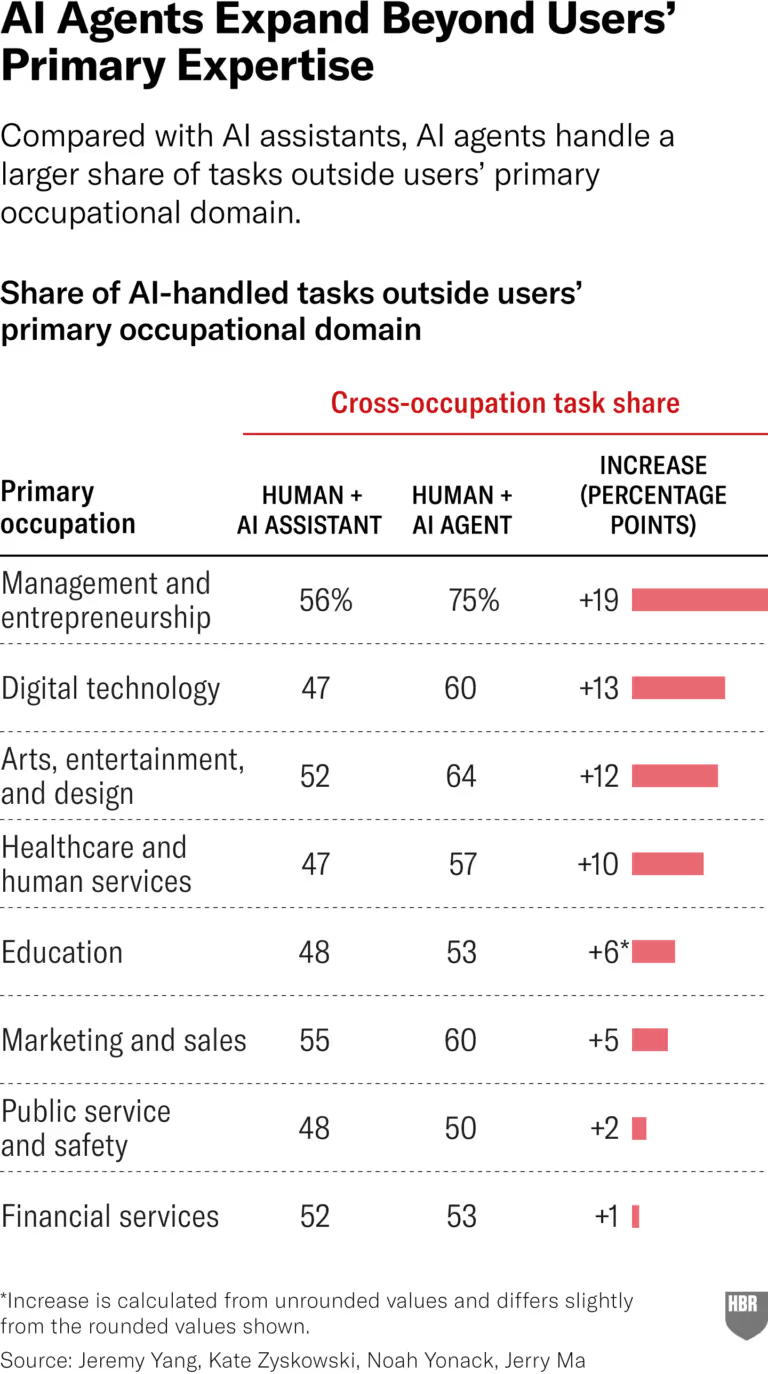
Both studies carry the same footnotes.
OpenAI is studying its own product and Perplexity's researchers are studying theirs. Both lean on automated message classification rather than human coding, and HBR's authors note their own sample skews toward early-adopter power users on a single product ecosystem. Treat the direction of these numbers as solid and the precise size of them as approximate.
Don't Rebuild What Already Failed
Here's where I finally part ways with the brilliant acid metaphor, with an instinct I've watched play out in every function I write about.
The reflex, when a wall cracks, is to patch it.
Tighten the job description. Redraw the org chart. Score the next performance review against the narrower lane the role used to occupy. Every one of those moves defends a dam the water already cleared.
I've made versions of this argument before, about:
- Who owns the frontline experience
- Teams that run like an API
- Leaders who can't redraw their own silos
This is the sharper version of that same problem. The old boundaries have gone from inconvenient to breached, measurably, in usage data your own AI vendor already has.
The real caution is for those rebuilding a wall the water has already crossed.
What Can You Do on Monday?
The flood is already out of your hands. What you still control is whether your organization keeps pointing hoses at a wall that's already down.
- Trace where the water's already gone. Pull a sample of what your teams are actually asking AI to do this month. You'll find crossover happening quietly, whether or not anyone approved it.
- Redraw one incentive built for the old wall. Find a job description, policy, or a review criterion that still assumes people stay in their lane, and rewrite it to match where the work already sits.
- Retire one scorecard measuring against a vanished wall. Pick a place you're still grading people against boundaries the data says they've already crossed, and let it go.
Or, better yet, write skills and documentation that help AI agents cross organizational lines to get work done faster, gated by the institutional knowledge of the people who built the walls in the first place.
Try as I might, I can't stop the lines from moving. But I can promise to keep walking you across them, one issue at a time.

How much of your people's real work is already on the other side of a wall you're still grading them against? If this resonates with your work, get in touch.