

Duct Tape and Favors
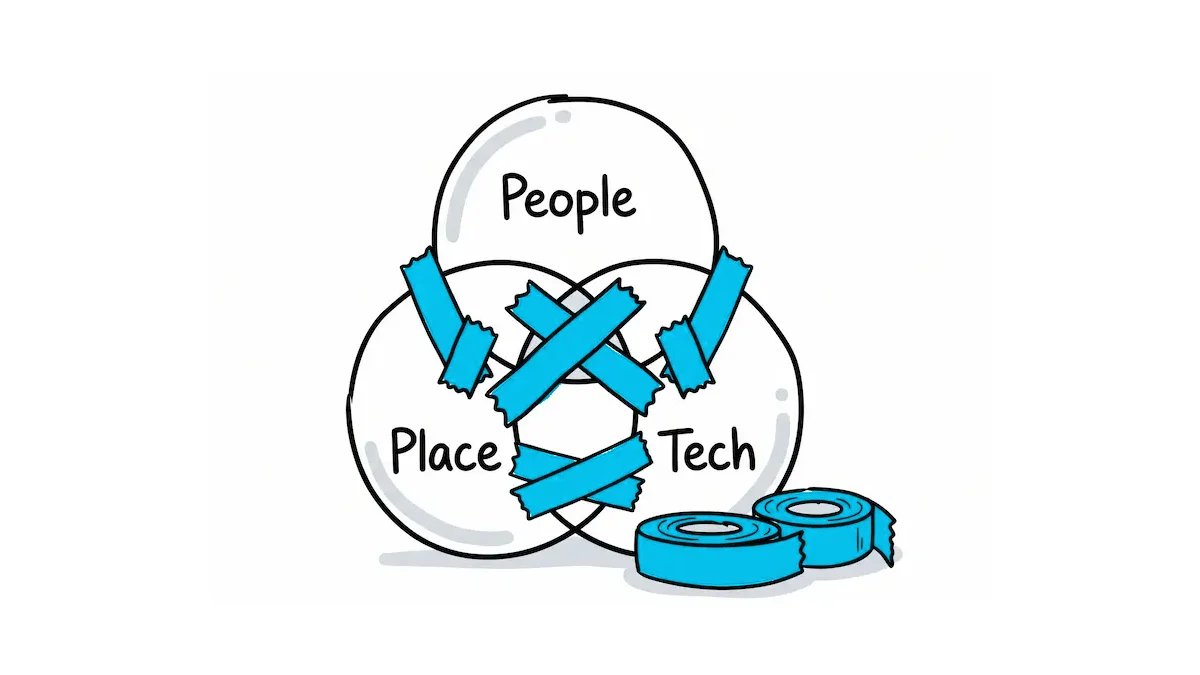
A few months ago, a workplace technology leader asked me a question about conferences: "Given my role at the intersection of people, place, and tech, are there any you'd recommend I add to my calendar?"
In a volley of video messages, I shared that he wasn't the first person to tell me it was hard to find events where truly cross-functional employee experience topics were discussed. For example, where a spatially-oriented technologist could engage with, say, an organizational effectiveness expert.
I said, "Groups like yours are all in a funny, middle ground, huh?"
Then he told me to "buckle up" for incoming commentary and sent me the sketch below. He marked himself where tech overlaps place. Then he pointed one lens over, where people overlaps place, and called the figures standing there "my trauma-bonded peers."
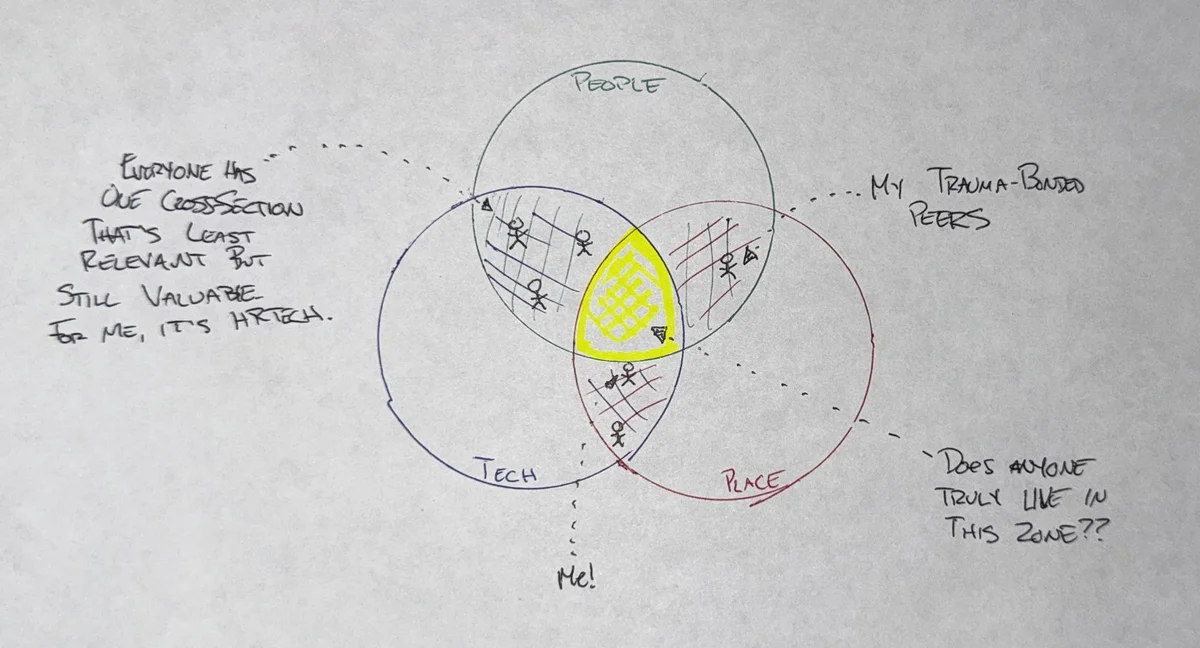
Trauma-bonded peers!
Hyperbolic? Perhaps. But I love it.
I write this newsletter because managing work experience across the lines between functions is hard. But I'd never heard such an evocative term describing what that arrangement does to the people holding it together.
So I went back through my archives to see what I had called them before, and realized I'd never properly defined the term.
The Misfits, Defined
I have used the word misfits twice in this newsletter, starting when I told readers to convene the misfits but didn't really clarify what I meant. In the same month, I wrote about a T-Mobile posting that asked for "influence without authority in a highly matrixed organization," and quietly buried a simple definition:
You own the outcome. Someone else owns the resources.
That is the test. A misfit owns an outcome that requires budget, headcount, or systems belonging to a chief who did not hire them.
Everyone has had a frustrating boss. That friction stays inside one function. The outcome I'm describing crosses structural reporting lines. Structurally and sustainably breaking these barriers requires cross-functional courage, and courage is a heavy thing to put in a job description, don't you think?
This means the misfits have been holding your employee experience together with duct tape and favors.
Mind the Gatekeepers
Even with best intentions to cross the lines, misfit leaders may encounter an insidious cultural reflex, and I've heard two examples in my client travels.
The first was a change management leader in real estate at a food and beverage company, who reached out to members of the Change Management team about collaborative opportunities. Both departments reported up to the CHRO, but the official Change Management team dismissively told the workplace change leader that they were not the same.
Another real estate leader at a technology company lost a technologist from his team. He went to HR IT for support and got turned down, because he "was not HR." His boss was the CHRO.
Both of them already reported to the CHRO, and neither one counted. The gatekeeping sits below the level that could authorize the change, which is why leaders cannot break their own silos.
That is why trauma-bonded lands the way it does; you only get a bond that strong by being turned away.
Duct Tape Can Break
But sometimes the stars align. Two people find each other, routing around the org chart, and something gets better. Could be onboarding, an AI rollout, or the annual survey. Positive intentions somehow leak through long-standing institutional barriers.
Then one of those leaders gets a new job, and the gap they held open closes.
Creative and collaborative solutions dissolve back into one function's "the way it's always been." Cross-functional committee meetings drop from the calendar. Silos and incentives seal up the leak.
Integration that runs through a person leaves with the person. Social capital dies in the silos, and it dies fastest in the seams where only one person was ever standing.
Look again at my friend's sketch. He drew a figure inside the yellow center where all three circles overlap — the same ground I have argued belongs to a Chief of Work — then wrote beside it:
"Does anyone truly live in this zone??"
Both things are true. People do live there, but they survive on borrowed authority. And nobody notices when they stop.
If your best integrator resigned tomorrow, what would the job posting say? If the honest answer is the old functional job, plus a hope that the relationships regrow around whoever you hire, the integration was personal all along.
Who Else Is on the Lines?
These are the roles I keep finding on the lines. They have no peers nearby because the people doing the same job sit in another function under another title.
- Head of Employee Experience (HR, to the CHRO). Owns the experience promise and convenes everyone who can affect it.
- Head of Digital Employee Experience (IT, into the CIO org). Owns the digital friction people feel every day.
- Head of Corporate Real Estate and Workplace Strategy (Real estate, usually to the CFO). Holds the physical experience and hybrid policy.
- Workplace Experience Manager (Real estate or HR, to the head of CRE or the CPO). Hospitality and the physical-digital seam.
- People Analytics and Employee Listening Lead (HR, to the CHRO). Owns the signal on how work actually feels, often including annual engagement surveys, but usually not where it happens.
- Organizational Change Management Lead (IT, HR, or a transformation office, depending on the program). Carries readiness and adoption for every rollout.
- Internal Communications Director (Comms or HR). Narrative, cascade, and manager toolkits.
- Enterprise AI Enablement Lead (Contested: IT, L&D, strategy, or a standalone AI office). The newest cohort, created into a structure with no slot waiting.
- Head of Inclusion and Belonging (HR, to the CHRO, sometimes the CEO). Accountable for representation, equity, and accessibility, while the levers sit in HR, IT, and real estate. Renaming may have scattered this title more than others.
The ones I have named before still stand: T-Mobile's Product Manager Employee Experience, Barclays' Ways of Working Execution Coach, Dentsu's SVP of Work Design, and my favorite, Deel's Ghostbuster. (Still not kidding.)
This roster is incomplete. Tell me what title is missing.
And if you have ever been told you were not one of them, I want that story too.
What Can You Do on Monday?
Org charts set the distance between the misfits. Invitations close it. Here are three ways to shorten yours this week.
- Draw your own three circles. Put people, tech, and place on paper, mark where you sit, and name the seam you have quietly written off. That seam has an owner somewhere in your workplace. Invite them for coffee.
- Grant membership before anyone asks. When someone from another function does work that rhymes with yours, add them to your standing meeting or community of practice. In both stories above, admission would have cost the gatekeeper nothing.
- Write the posting now. Take your most effective cross-functional person and draft the job description you would run if they quit on Friday. If it reads like the old functional job, you have found work living inside one person's relationships.
Not one of those three requires budget, headcount, or permission. Just some favors and duct tape.
Both hold. Neither survives a resignation.

Who in your organization is doing integration work that would walk out the door with them, and what would it take to make that work structural before it does? If this resonates with your work, get in touch.