

Your Vendors Are Change Agents

I've been using the same slide for a decade: roughly two-thirds of change programs fail to meet their objectives. Not because of bad ideas or insufficient budget, but because of something deeper, like a failure to properly define the change or secure real sponsorship.
I opened a panel with that slide at the Society for Hospitality and Food Management (SHFM) Critical Issues Conference, then moderated a conversation with three leaders who, together, have led change programs across some of the world's most demanding workplaces.
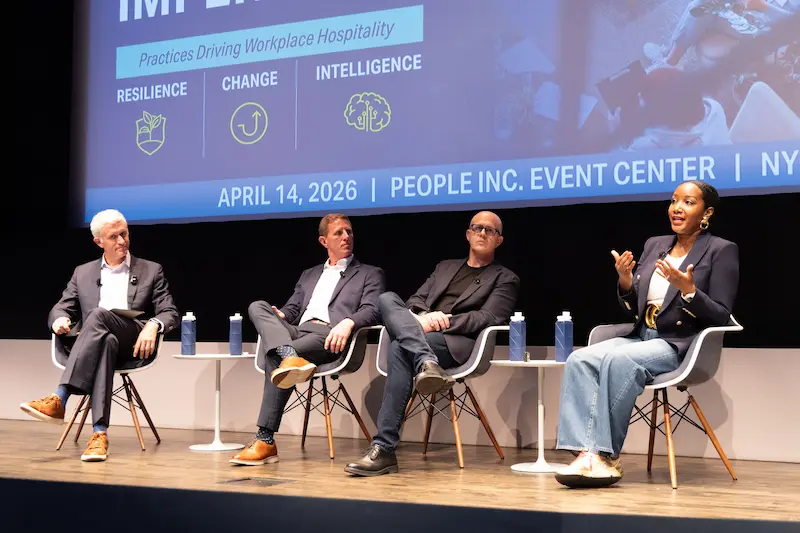
What surfaced applies well beyond hospitality: vendor partners rarely play a role in establishing a change vision or mitigating resistance.
Which made me see the lines of modern work in a whole new way.
Why is this change happening?
I’ve previously shared a list of 40+ questions to comprehensively define a given change program – covering the who, what, where, when, why, and how. But in the interest of time for the panel, I boiled it down to the one that matters most from the perspective of the change leader:
Is this change happening because you wanted to do it, because you were told to do it, or because you have to do it?
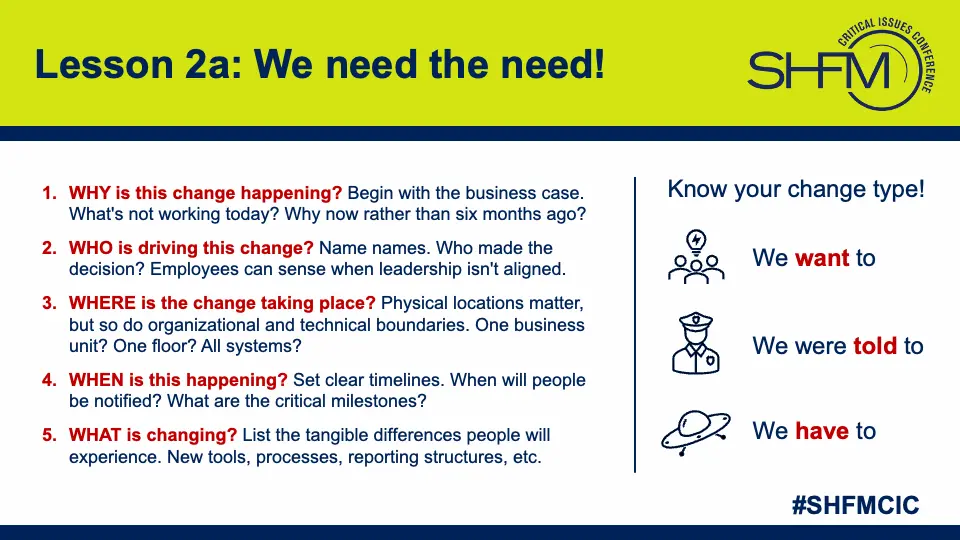
The difference matters because the potential resistance to the change will play out very differently depending on which type of change people believe they're in. And it’s possible that the same initiative can read as all three simultaneously, depending on the perspective.
As you’ll see in the examples below, a leader may want to do something where employees feel they’re being told to do it and external partners feel obligated to go along.
Same program. Three change experiences. Often, there is no recognition of that difference.
The straw that broke the camel’s back
Regine Hooper-Campbell leads global hospitality strategy for Airbnb's offices, developing healthy and nourishing food philosophies and working with a global network of partners.
In support of the company’s sustainability initiatives, Regine’s team had successfully eliminated straws and was looking for their next bold move. A colleague proposed meatless Wednesdays. After some initial hesitation, the team decided to proceed with confidence.
"We're bold. We're in California. We can do this," Regine recalled thinking. She drafted the communications and sent them out.
By the next morning, the hospitality team was inundated with emails and Slack messages. Someone even asked why meat had been removed during the open Q&A at a CEO town hall. I remember a similar backlash when I was at WeWork.
Regine shared her reflection during the panel: "We were so in love with our idea that we didn't think about how it would impact people.”
On the surface, the initiative made sense and aligned with Airbnb's values. But I suggested on the panel that the sequencing may have been off.
I’m a fan of “North Star” vision statements, which employees can buy into before specific workstreams and pilots are attached to it. “We want to reduce our food program's carbon footprint meaningfully," is engaging. Spontaneously going meatless on Wednesdays is enraging.
Beyond the order of operations, our panel also surfaced a realization that inspired this article. Regine's food service partners see every employee, every day, in every office — and they were not consulted about the meatless idea in advance.
The change cup is empty
Stuart Gonsuron is a capital projects leader at JPMC, but previously oversaw employee dining services for the company’s North American portfolio. “It’s a very emotional topic,” Stu said during his introduction. “People have a lot of opinions about their food.”
Stu shared his own story of being caught off guard during a change program. In the name of physical security, the company sought to reduce the number of external workers entering the building through loading docks instead of lobby turnstiles. And it turned out that the bank’s use of paper cups was fueling a lot of that delivery and replenishment traffic.
So, to reduce both security risks and environmental waste (a double win!), the hospitality team decided to eliminate paper cups and gift employees insulated, reusable ones. Internal Communications fully backed the plan, and the team had calculated the carbon impact.
“But we got annihilated,” Stu recalled not-so-fondly.
Employees who had recently been notified about stronger return-to-office policies didn’t hear “less risk, more sustainable.” They saw it as an inconvenience. "You're making me come in more and I have to bring my own cup?!?”
The legitimate rationale that initiated the program never made it into the public framing. Employees engaged with the version they could see and argued with it on its own terms.
And here too was a supplier dimension.
The program implied that delivery volume and access were the problem, which positioned the very partners responsible for those deliveries as part of what needed to change. Hard to show up as a co-designer of a program that has already cast you as the issue.
And once again, those partners were not consulted on the vision or solution.
The service provider's view
Rob Gebhardt leads workplace experience for JLL accounts in the Americas, the other side of the contract in both stories above.
When JLL onboards a new account, Rob sees multiple change programs bundled into a single program, though almost nobody manages them that way. The client experiences a vendor transition. The employee who changed their badge may experience a personal disruption. The provider absorbing that employee has an entirely separate change on their hands, one that rarely aligns with the client's timeline or definition of success.
In response to his co-panelists’ stories, Rob also agreed that most programs fail to align on outcomes, not just on task completion. Things get done. Whether the change actually landed for the people it was supposed to serve is a different (and usually later) question.
This matters most with frontline workers for two reasons.
First, the barista, café attendant, and micro-kitchen staff absorb employee sentiment every day. They probably hear and feel feedback before any survey goes out. They know which ideas will create friction before the program launches. Getting them and their supervisors into the change and vision definition process is good intelligence, not just good intentions.
On the flip side, frontline workers have no particular reason to serve as change agents for a client organization. Their loyalty, attention, and incentives belong to the provider who employs them. If you want their pattern recognition and proximity to inform your change programs, the relationship with the supplier must be designed for partnership, not procurement.
Order-takers don't volunteer intelligence.
AI won’t fix everything
As I wrote in The Relocation Vocation, AI is compressing administrative and coordination layers, such as scheduling, compliance reporting, and data reconciliation. This creates excess capacity.
But the changes that went sideways in the above stories had nothing to do with administrative overhead. They suffered from misaligned change definitions, visions, and/or sponsorship. Employees lost autonomy, vendors were excluded from conversations, or frontline staff were left to absorb unexpected friction.
AI will not build the trust that makes a vendor willing to tell you an idea will fail.
While wrapping up the panel discussion, Regine turned to the audience, primarily service providers, and told them it’s okay to be vulnerable with their clients. Don’t be afraid to suggest ideas that might not work out as expected, or to challenge clients’ ideas and requests. This is how stronger bonds are formed.
“You’re an expert in your field,” Regine reminded them. “Lean into that.”
Your vendors are watching what works and what doesn't across their accounts, and therefore have a high degree of pattern recognition. But they’re rarely asked to apply it to support client-directed change programs.
What can you do on Monday?
Most transformations that cross organizational lines fail upstream, at the definition stage. The people with the most relevant signal are on the other side of the contract.
Here’s where to start turning your vendors into change agents:
- Map the handoffs. When next establishing your vision for a better future state, identify every place where execution might cross to/from a provider. Use those handoffs to define the change, starting with what kind of change it is.
- Vision with your vendors. Ask your key service partners what problems they're seeing across accounts. Give them the “North Star” draft before the work plan is presented. You'll get better implementation and earlier warning on what won't land.
- Talk to the frontlines. Whether it's the people running your cafe, managing your IT help desk, or answering the benefits support line, they speak to your employees every day. Before the next change touches their work, ask what they're already hearing. The survey can wait.
The change you think you're running and the change your vendor is experiencing are rarely the same thing. Close that gap before you launch.

How might your transformation outcomes shift if you positioned your key vendors not as service providers executing your directives, but as essential partners in defining the change itself? If this resonates with your work, get in touch.