

Wanted: A Forward-Deployed Black Belt
Back in May, I emailed Ben Zweig about a hunch.
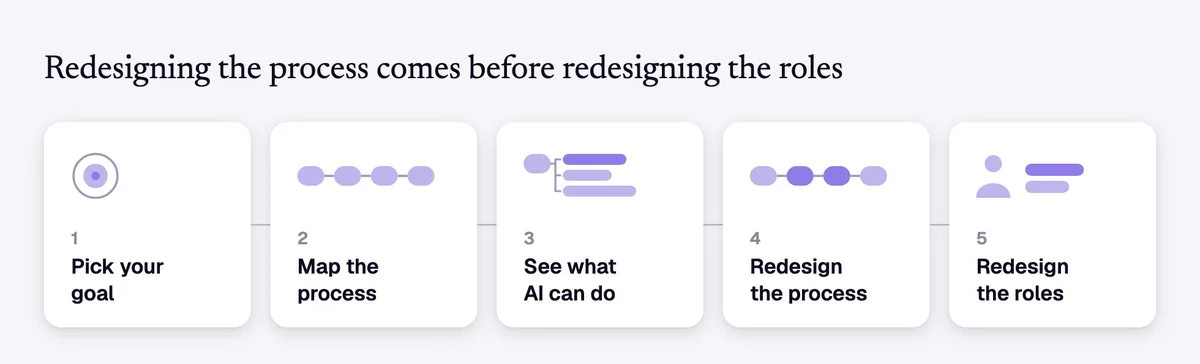
Ben runs Revelio Labs, a workforce data company. I attached two how-to guides I liked from Microsoft's 2026 Work Trend Index. The first walks leaders through rearchitecting a workflow: pick a high-impact process that recurs, follow one real request from start to finish, then cut, combine, standardize and clarify. The second covers role redesign.

Both are written for leaders, and assume someone on a team already knows how to map a workflow and renegotiate the handoffs inside it. My hunch was that few organizations have somebody in that seat, and I was hoping Ben's massive data lake held the proof.
In my email, I hypothesized that companies "may be over-hiring for tactical AI adoption skills and under-hiring for the work redesign capabilities needed to realize AI productivity gains." Prompt engineers and AI trainers on one side. Process improvement, operating model design, Lean and Six Sigma on the other.
Nearly every consulting report I've read this year says AI value depends on redesigning the work. Very few say who should do it.
Five months after my exchange with Ben, OpenAI's Chief People Officer gave the missing person a name.
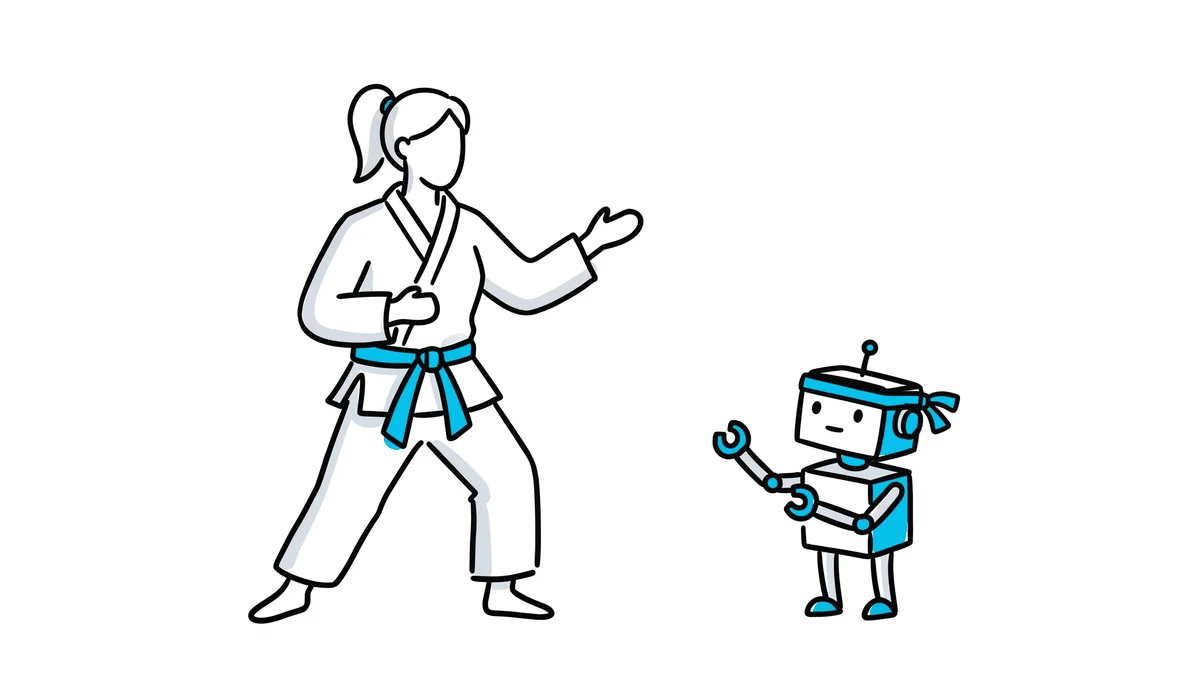
Enter the Black Belt
Earlier this month, Arvind KC, now Chief People Officer at OpenAI, posted that the leaders he talks to "all keep arriving at the same bottleneck." Most have "a reasonable handle on technology" and data. They are stuck on "redesigning workflow to make it a combination of humans and agents," and on what a role means once agents do much of the work in today's job descriptions.
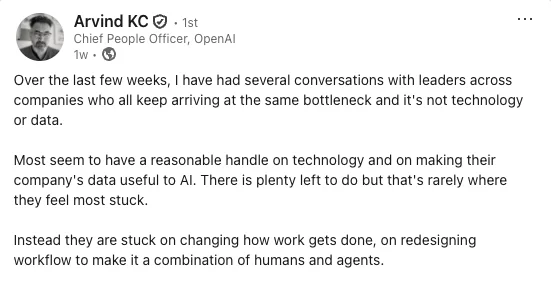
His fix is a "forward-deployed black belt," someone "who works alongside a team, understands the work, and helps redesign it with humans and agents." Picture forward-deployed engineering and Six Sigma black belts having a child, he wrote. He also admits the old title comes with "some organizational scars," and that "everything cool has to have the 'forward deployed' prefix these days."
I interviewed KC when he was Roblox's Chief People and Systems Officer, running HR, IT, InfoSec and Real Estate. My takeaway then was that putting AI into people processes takes hard work in the underbelly of the workflows.
Commenting on KC's new post, I said I worry that forward-deployed engineers are often too technical for the human negotiation that redesign requires. I also said I see far more engineering roles posted than Lean or process improvement roles.
Ben's team was game, but my side question could not jump their queue at the time, which is fair. So I ran a quick search on Indeed that I'll share in a moment. First, a quick refresher on black belts and those scars.
Where the Belts Came From
Toyota built its post-WWII production system around one habit: remove every step that adds no value, then do it again. The West later called it Lean.
Six Sigma started at Motorola in 1986, when an engineer introduced a statistical method for driving defects down. A year or so later, Mikel Harry was on sabbatical from Motorola at a Unisys plant in Salt Lake City and suggested calling the trainees Black Belts. The plant manager replied, "That's sexy! I can sell that." Jack Welch then made Six Sigma central to GE's strategy in the mid-1990s.
Michael Hammer had pushed similar logic in his 1990 Harvard Business Review article, "Reengineering Work: Don't Automate, Obliterate": get rid of work that adds nothing for customers before you spend money making it faster.
Many companies used reengineering as cover for downsizing, and that is where most of the scars come from. At 3M, former GE executive Jim McNerney pushed Six Sigma into the research labs, and the company's research chief later admitted, "We got a little tool happy."
Microsoft's cut, combine, standardize and clarify are close cousins of ECRS – eliminate, combine, rearrange, simplify – an old industrial engineering checklist, though the guide never says so. The methods outlived the backlash, which leaves the question of what happened to the people who know them.
Many Engineers, Few Belts
While writing this article, I had my AI pals help scan a few job boards for me. Bulletproof? No. But still interesting.
US job titles on Indeed containing "forward deployed" outnumbered titles containing process improvement, operational excellence, Six Sigma or black belt, by nearly 3 to 1.
"Process improvement" appears somewhere in about 150,000 postings, but usually as a line in someone else's job description. As a job title, "work design" showed fewer than five times, and I'm already planning to feature one of those new hires in a future article.
Thirteen of the first 15 forward-deployed listings I checked were at AI and software companies, whose forward-deployed staff implement their own product inside a customer's business. The few roles built around redesigning work cluster in HR and consulting, and two caught my eye.
Ford is hiring a Senior Manager, AI Workflow Redesign, with at least three years of mapping current-state processes required. Protiviti's posting for an AI People Enablement Manager defines the work more precisely than most reports I read this year: break work into activities, design human-agent workflows with decision rights and escalation paths, then turn the result into team structures. Lean and Six Sigma are among the preferred backgrounds.
Plenty of Prescriptions
While my AI pals scanned job boards, I also read six months of consulting reports and business press on redesigning work.
McKinsey says nearly three-quarters of AI high performers have "fundamentally redesigned workflows," a survey checkbox it seemed not to fully define. Of the 21 pieces I reviewed, eight named no owner at all. Microsoft presents Camp AIR, three weeks of protected time with internal coaches, as workflow redesign. A new Charter playbook treats the same program as change management. At Fortune's recent AIQ Summit, executives from ServiceNow, HPE and Booking all called for rethinking processes from scratch. The answer to who does it was "leadership."
The most complete method I found came out last week, from my former McKinsey colleague David Mendelsohn, now at TechWolf. His five-step version ends where Microsoft's two guides split: redesign the roles from the new process. Yet even his method leaves one question open: who runs it?
Everyone prescribes the black belt, and very few companies post the job.
What Can You Do on Monday?
Your organization likely employs black belts (or similar process ninjas) already, under a different title or reporting to nobody in particular.
Want to start moving the work design needle?
- Find the belts you already have. Search your HR system and internal profiles for Lean, Six Sigma, process excellence and industrial engineering experience. Many of those people sit in operations, finance or quality, working on something else. They already know how to map a workflow and run a pilot.
- Give one workflow an owner. Pick a high-volume workflow that AI is already touching. Name one person accountable for the current-state map and the redesign, and protect their time the way Microsoft did with Camp AIR. Fund it as a project, separate from the tool rollout.
- Write the job down. If the work pays off, post the role with a real title and reporting line. Decide whether it sits in HR, IT or operations before a vendor's forward-deployed engineer becomes your default answer.
KC is right that the black belt needs a new name. It also needs a boss.

Who holds the process map in your organization today, and would they recognize themselves as a black belt? If this resonates with your work, get in touch.