

Does Your AI Transformation Have an Office?
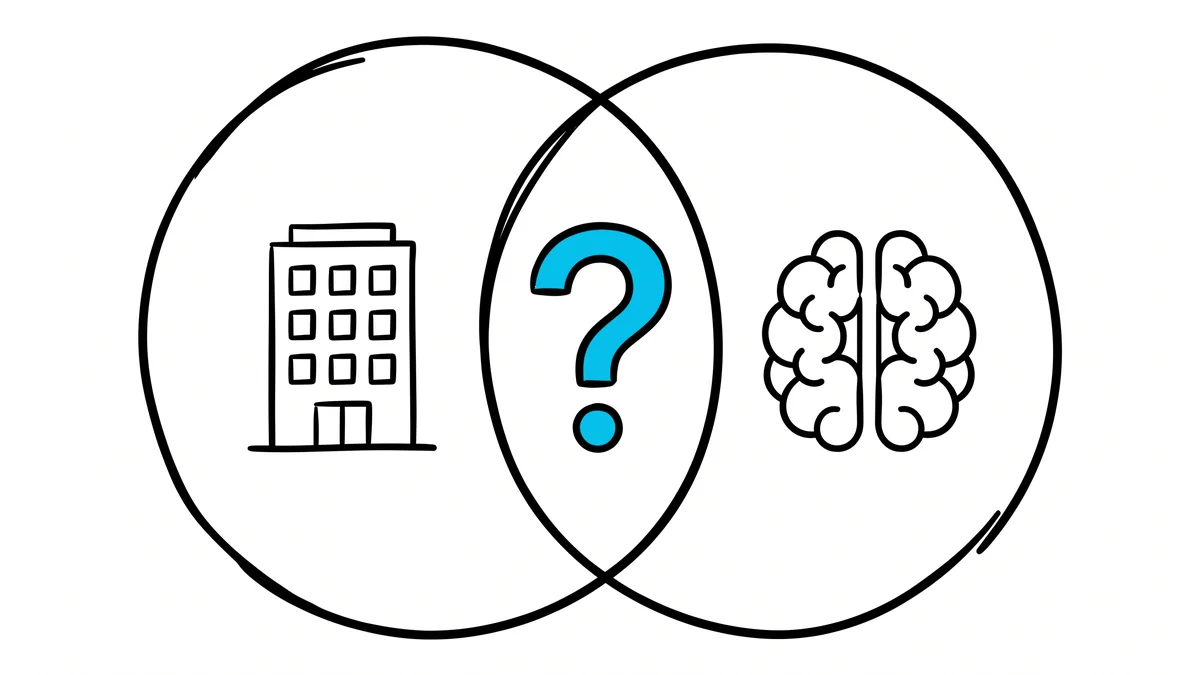
For the first time in my three years as an independent consultant, I am serving the same client in two different capacities. And it's sharpened a hypothesis I've been thinking about a lot during the corporate work transition from "Get Back to the Office!" to "Use AI or I'll Fire You!"
The client is a consumer brand relocating to a new headquarters. I have been pushing their People leaders and change champions to define what the new office should be for, in terms people can feel and the business can measure.
Know what else is featured in their executive communications? AI transformation, of course!
The same client also booked an executive immersion workshop with Lead with AI, where I'm a Transformation Partner. It went well enough that champions now get a tailored cohort of their own. Yours truly will be facilitating some of those classes.
I bet a lot of companies have similar HQ and AI initiatives, though not necessarily at the same time, like my client. The same CEO sponsors both. The same employees will walk into the new HQ and fire up the same AI tools. Unfortunately, the two strategies are not (yet) aligned as tightly as I believe they can be.
So I went looking for a company that had already connected the two.
And I came up empty-handed.
AI and the Office
The first question I ask any workplace team is what the building is for. In How I Stumped a Panel of EX Experts, I argued that every employee experience investment needs a business hypothesis up front: improve a specific experience, expect a specific outcome, and say why. I have yet to see a company write an office hypothesis with AI adoption as the outcome.
Don't get me wrong, there is plenty of research on how AI will impact our offices.
JLL's Future Vision research, for example, predicts demand for "smart workstations enabling seamless human-AI agent interaction." I wanted the reverse: a company outside the design, furniture, and AI industries saying its workplace explicitly supports its AI transformation. So, naturally, I ran an AI deep-research query to see what I could find.
One match came through a supplier: Microsoft's WorkLab cited BNY's 40-hour AI bootcamp on the 11th floor of its Manhattan HQ, with ~2,300 graduates since April 2025. The building hosts the program, but I don't believe BNY credits the building for adoption.
Atlassian, of cost-per-visit fame, came closest in its own voice. A July post from Head of Workplace Gina Creegan lays out a framework for the "AI-enabled office," and Head of Workplace Design Florian Kaiser says the company uses its offices "to experiment with how AI is reshaping teamwork."
But the framework serves teams already using AI. Adoption sits outside its scope, and Atlassian sells AI tools.
Cisco's Chief People Officer Kelly Jones reported in January that employees who choose to come in three or more days a week are more likely to use AI tools, and that employees whose direct leaders use AI are twice as likely to use it themselves. Cisco treats the office link as a maybe; engaged people may simply do both. Gensler co-chair Diane Hoskins told HR Brew the firm is seeing its first "significant increase" in in-office learning in about 20 years.
Her explanation: "There's no manual."
Now, I'll admit that an AI deep-research query has limits. Many design briefs and purpose-of-the-office statements may live in private, internal documents only. Still, nobody outside the vendor world seems to make this case where I could find it. My guess is still that plenty of companies run the two as separate bets.
Test the Building
Nancy Baym and her co-authors argue in HBR that AI adoption stalls when learning stays invisible. Cisco saw a related risk. Its most active AI users trusted their teams less than intermittent users, Business Insider reported, and Cisco concluded that "AI can unintentionally create isolation when it's adopted individually rather than collectively." Gensler's AI power users, by contrast, report stronger team ties. My read: the difference is whether people learn AI alone or together.
A skeptic will say the ritual matters more than the room, since a show-and-tell also works on Teams. Fair, and the office only reaches people who can get there. But a company about to design an HQ should still test how much of the load the building can carry.
The first case study would write AI adoption into the brief as a hypothesis, something Atlassian's framework also recommends: "Pilot modules with explicit hypotheses and success metrics." In the hypothesis format from that EX panel: "If we make AI experimentation visible in the office, we expect faster adoption, because people learn AI by watching colleagues use it."
The measure should satisfy a skeptic, like the number of employee-built use cases that reach production. Then compare teams that learn in the space with teams that learn remotely, using shared HR, IT, and Real Estate data.
Owning that test end-to-end could be the Chief of Work idea applied to the journey of AI fluency and transformation.
What Can You Do on Monday?
If your company has an AI mandate and a major workplace decision on the calendar, here are three ways you can bend the parallel schedules so that they meet at least once.
- Write AI into the building's purpose. Read the workplace or HQ brief next to the AI transformation plan. If advancing AI adoption is missing from the stated purpose of the space, add it, along with two or three metrics that would tell you it's working, before anyone picks furniture.
- Start a ritual before the ribbon-cutting. Run a monthly show-and-tell in the office you already have, led by champions from your change network, and stream it for everyone else. Track who shows up in each room and which ideas become working use cases.
- Trade one seat each way. Ask the AI steering group to add your workplace lead, and ask the HQ project to add someone from the AI program. That person makes sure the designers use the research on how AI changes what people need from desks, meeting rooms, and social spaces, starting with acoustics now that more people talk to their tools and rooms.
Your AI transformation probably has an office already: a program team with a steering group and a roadmap.
Give it an address.

If your next office had to make your people measurably better at AI, what would you build, and how would you know it worked? If this resonates with your work, get in touch.