

Return on Place Stops at the Lobby
A new HBR report built its case for the "knowledge campus" on the HQ that a major global bank spent billions to rebuild. I know a few things about that project.
While at McKinsey, I co-authored a piece on the future of financial-services HQs, informed in part by work on that same campus. The brief went well past collaboration and innovation. We wanted a building accountable for outcomes that a leader could name and measure against.
I'm glad when "future of work" reports take the built environment seriously. The argument is strong, and I like the idea of a "return on place" metric to gauge how well a location supports collaboration, eases the commute, and strengthens culture.
But the thesis seems to stop at the lobby.
Return on place measures the building and the surrounding blocks. It says little about the part that decides whether any of it works: the people, the tools, and the journeys and rhythms waiting beyond the doors.
And the finest building in the best district can still hold a miserable team.
Checking the Scoreboard
The case studies that anchor Richard Florida and his co-authors' report share common traits. Hudson Yards and One Vanderbilt in NYC. King's Cross in London. Roppongi and Shibuya in Tokyo. Every example is either a master developer building a neighborhood or a Fortune 50 occupier spending billions on its own HQ.
Most companies operate within ecosystems someone else built.
The same orientation appears in the report's one data exhibit. The graph's y-axis is "commercial success," measured as 2018–2024 rent growth and 2024 vacancy. Its x-axis is the knowledge campus index, comprising functional diversity, interaction density, sector clustering, and transit connectivity.
Read charitably, it's persuasive. Soft outcomes (collaboration, culture, life productivity) wrapped in hard metrics (rent and vacancy) work for a real estate audience. They work less well for HR, IT, and Finance. The report also includes work-productivity and life-productivity comparisons between knowledge campuses and traditional downtowns, but only the real estate metrics are shown in a chart.
A framework that proves itself with rent growth is written from the vantage point of the people who collect the rent. It asks corporate leaders to stop thinking like landlords, then measures success exactly like one.
A New Name for an Old Aspiration
Return on place describes outcomes leaders have been claiming for offices since the 1980s: collaboration, innovation, culture. Asserting them has always been the easy part, but measurement remains elusive.
A new metric built on the same goals inherits the same problem.
Two of the four dimensions in the report hold up. Commute friction (what the report calls "life productivity") and ecosystem density are observable from the sidewalk. Count train lines, count cafés, walk the blocks around the front door. But the other two dimensions assume someone inside the building can measure the impact of workers' activities, or connect them to workplace choices. That is the wall every collaboration, innovation, or culture program has hit for years.
Atlassian's cost-per-visit is what a place metric looks like when it works: a single, declared purpose the office must serve, with a worker outcome attached. An office trying to be everything for everyone ends up only moderately good at most things for most people.
The knowledge campus index starts with the dimensions. The Atlassian model starts with the goal.
Who Has the Data?
The HBR report skips over the question of who. Managers should assess interaction density. Location assessments must look beyond the walls of the building. The instructions assume someone is already in position to follow them.
I believe companies struggle to calculate return on place, or any similar value metric for the office, because of the lack of functional responsibility and the capability to measure its components. Who can instrument informal interaction and blend badge, HRIS, and sentiment data across the silos that hold each piece? The function it assumes is the one missing the authority, data model, and seat to build it.
The failure to prove place creates value is a positioning problem.
A real estate team still defending its budget on cost-per-square-foot has little trust currency to ask for login data from IT, attrition data from HR, or experience signals from communications. The "second-largest expense" framing keeps the conversation inside Finance's review cycle and out of the strategy room.
Each of those functions has its own version of the gap. HR holds people analytics, IT holds tool usage, Finance holds the cost model. The integrated picture lives in the gaps.
A metric that presumes an empowered, cross-functional function quietly assumes away the hardest part.
The metric is downstream of the org chart.
Magnificent Buildings Hold Miserable Teams
Hudson Yards holds thriving teams and miserable ones. One Vanderbilt houses real estate functions with seats in the strategy room and ones working as order-takers. Same magnificent district, opposite outcomes.
The variable that decides the result lives inside the building. The district holds constant, but purpose, ownership, and measurement vary. My old McKinsey report, informed by dozens of internal and industry interviews, anticipated some of the HBR thesis. "From urban silos to campus-like communities" is the knowledge campus.
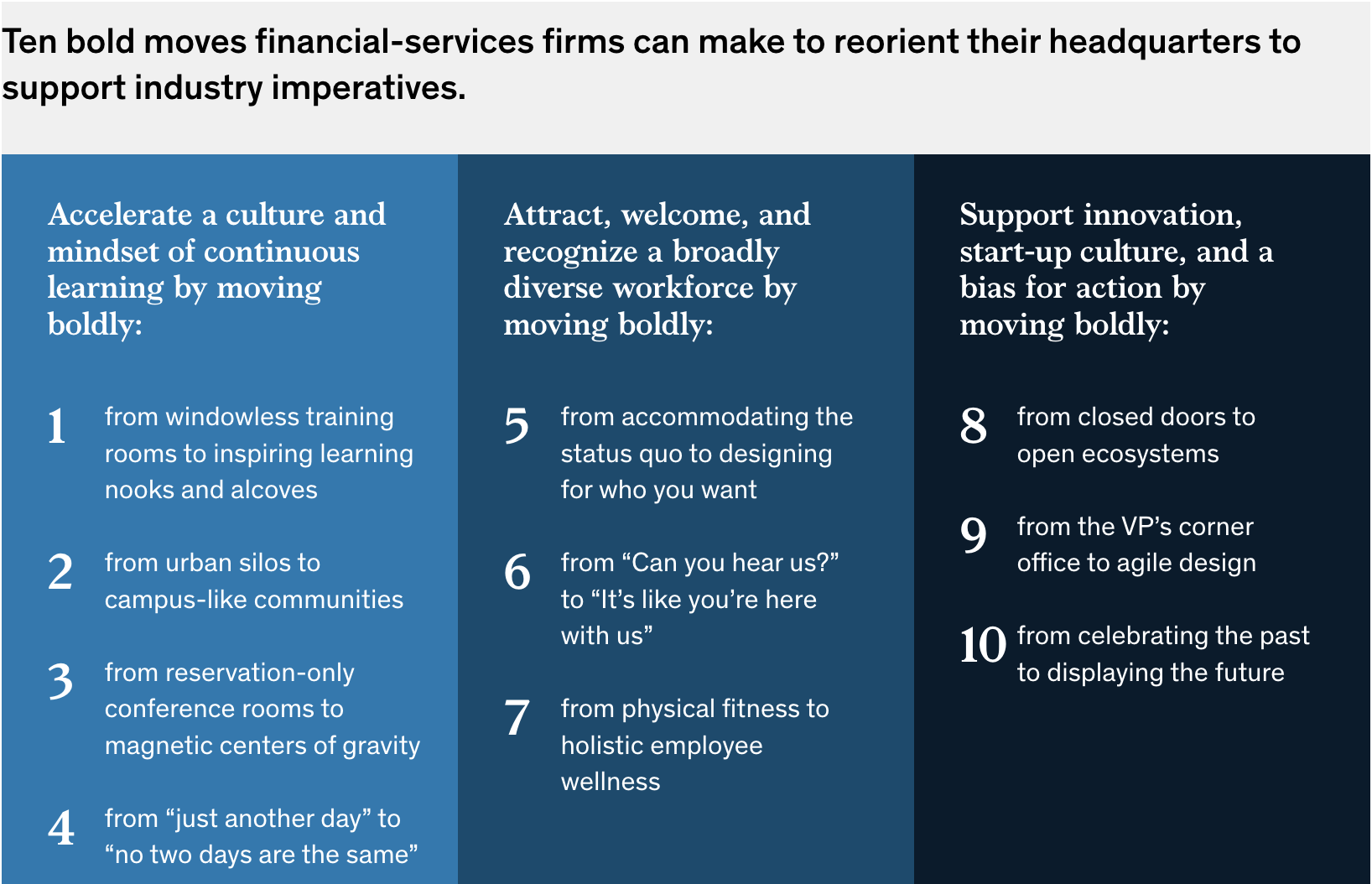
The HBR report also lacks the qualifier I included while at McKinsey:
"Real estate lies at the core of these initiatives, but their success requires a CEO-led, data-driven, iterative, and cross-functional approach."
That's a precursor to my Chief of Work argument.
In theatrical terms, the report measures the stage and calls it the performance.
The Ecosystem You Can Rent
The HBR report misses the power of micro-knowledge campuses created by flexible workspaces.
The report's own description of Tokyo's hero districts notes that the towers function as vertical cities "with hotels and apartments on the upper floors, restaurants and clubs in the middle, and innovation hubs and coworking spaces at the bottom." Flex is built into the report's best examples but not included in its best recommendations.
Coworking can be a knowledge campus rented by the seat, rather than bought by the city block. In London, flex space has grown from roughly 6% of office stock in 2019 to 10–12% today, with CBRE and JLL both forecasting 20% or more by 2030. New York sits at less than 3%.
For smaller companies that operate in a multi-tenant ecosystem, a flexible floor or coworking membership delivers what the campus promises: cognitive diversity, a mixed tenant base, and the collisions that build social capital. And it's much more affordable than a billion-dollar building.
What Can You Do on Monday?
HBR putting place at the center of strategy is welcome news. The conversation is still rare outside of real estate service-provider materials. The harder question is what it would take to operationalize the idea, and the work lands by function.
- HR, stop using attendance as evidence. Name the specific purpose an office serves for your population, connect that to the workforce data you already hold, and establish journey owners.
- Finance, test the underwriting. Require purpose and outcomes before capital clears for any major real estate decision. Cost per square foot has long been a placeholder for the real question: what value is this place supposed to create?
- IT, build the integration layer the metric needs. Help connect badge, booking, HRIS, collaboration, and sentiment data into a work operating system.
The lobby is the easiest part of the building to redesign. The work that decides whether the redesign pays off lives upstairs.

What specific outcomes would you measure to prove that your physical workspace is actually enabling the collaboration or focus you claim it's designed for? If this resonates with your work, get in touch.