

Remote-First Orgs Are Probably Healthier Than Yours

Darren Murph became Internet famous in the early COVID days thanks to his then role as the Head of Remote for GitLab, a company that was born remote and extremely generous with their knowledge of how to do it well. He's continuing that trend through his new book, Distributed: Secrets to building radically healthy remote teams, which comes out in a few weeks.
While composing it, Darren kindly asked me to share some perspectives — "from a few sentences to a few paragraphs" — and I suggested he tell the McKinsey OHI + GitLab story, which I had documented in a four-part LinkedIn thread in late 2023.
To my surprise and incredible honor, Darren loved the idea so much that he decided to make our story the foreword of his book. So, in the hopes of inspiring you to buy (many copies of) his book, I'm finally summarizing my original LinkedIn post series into one place.
It starts in late 2023, in front of a room of real estate and facilities leaders, where I told them I could prove a fully remote company had higher organizational health than their firm probably did.
The Cool Kid Problem
My clients had been asking the same questions on a loop since 2020:
- What is the right hybrid model?
- What are other companies doing?
- How many days should employees be in the office?
- How do I get more of them back?
- What happens if I mandate attendance?
All five were location questions, when the real difficulty of making distributed work sustainable sat one level down, in decision rights, communication norms, and documented ways of working. Remote-first companies were publishing free guidance on exactly that, but nobody counting badge swipes was looking for it.
I said as much to one remote advocate at the time. Most fully remote companies are cool kid companies, I told them, and the employers you are preaching to are not. They either don't know you exist or don't care what you're saying, because they have no way to judge whether any of it is true.
Credibility was the gap, so I proposed borrowing some.
Without knowing what the outcome would be, I recommended measuring a natively, intentionally, and thoughtfully remote company with McKinsey's Organizational Health Index, a framework the not-quite-so-cool-kid companies had grown to trust and respect.
OHI 101 and a Two Year Journey
McKinsey defines organizational health as how a company aligns on a common direction, executes with excellence, and adapts to change, the best predictor of long-term financial and operational performance. Healthier organizations see 3x higher total return to shareholders, and health explains up to 50% of the performance variation between business units.
Worth being clear on one thing. OHI is not an employee engagement survey, where most questions start with "I feel" or similar. It measures how often employees actually observe specific management practices. Plenty of highly engaged workforces are lousy businesses.
Pointing OHI at a fully remote company had a second benefit. When everyone works from home or a coworking site they chose, the results equalize for the complex variable of physical workplace. Hold place still and you can finally see what else is driving the score.
Getting it done took over two years, most of that persuasion. Inside the firm I had to argue that a benchmark built on traditional organizations should be pointed at a company with no offices. Outside it, I needed companies willing to be measured against it, knowing a mediocre score would go straight to every critic they had.
Darren, then Head of Remote at GitLab, said yes, which opened doors for other natively-remote companies to participate.
A Shocking Result
The fully remote companies I studied, notably GitLab, were top decile performers (beating 90% of companies) for organizational health, as measured by a 20+ year instrument.
One finding really stood out. Knowledge sharing, one of the management practices OHI measures, asks how frequently employees see leaders encouraging people to share learnings across teams. GitLab set the record.
Remote-first companies are very, very good at knowledge sharing, because if they were not, the whole house of cards would come tumbling down.
But that's not the coolest part. Early in the pandemic, the firm's org scientists looked at which practices were most helpful in preventing financial disruption, which is a nice way of saying probability of bankruptcy.
What practice topped the list? You guessed it: knowledge sharing.
Clear Norms are a Game Changer
The GitLab work changed the instrument itself. OHI had never been a workplace survey, so two new question types went in. One asks where people spend their working time, phrased around being on-site instead of "in the office," since plenty of OHI clients run warehouses and hospitals. The other is a short set of perception questions about flexibility.
Those flexibility questions went out to a broad canvas of workers rather than a single company, and produced the finding I still lead with.
- Employees who feel they have flexibility in where and when work gets done are ~1.5x more likely to report a positive work environment and culture.
- Employees who agree with why they are asked to be on site are ~2.5x more likely.
- Employees whose teams have clearly established norms for where, when, and how work gets done are ~3.5x more likely.
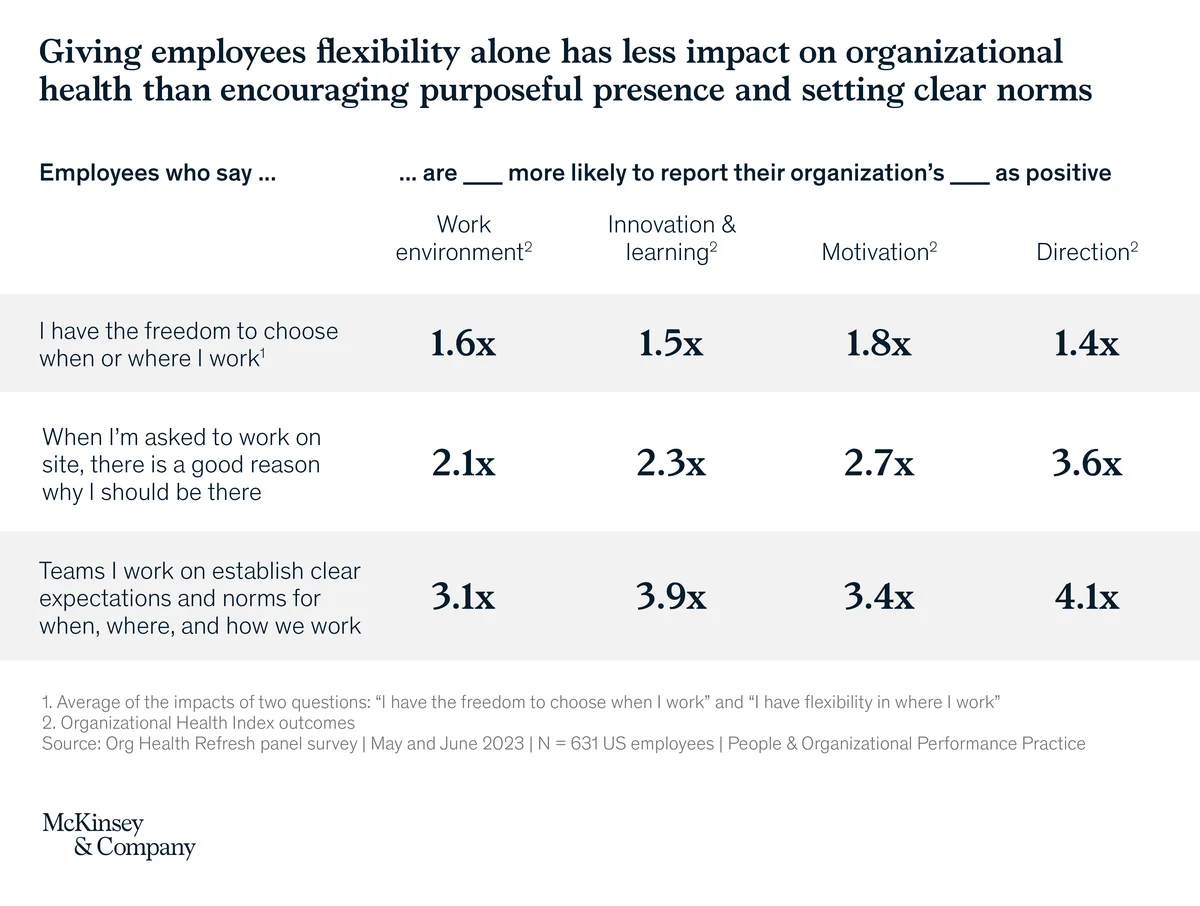
The same escalation holds for innovation, motivation, and strategic direction.
Now read those three again.
Flexibility helps a little. Telling people why you want them together helps more than twice as much. But the biggest jump comes from writing down how the team actually works. Location is the weakest lever on the list, and that holds even if you want everyone at your company sat next to each other.
I published the findings in February 2024.
Remote-Friendly Is AI-Friendly
My contribution was the proof. Darren built the thing being measured, and has now written down how. His framing for it is an invisible skyscraper: team agreements are the wiring, the project management system is the plumbing, documented guidance is the signage.
And there is one more reason this matters now, with nothing to do with where anyone sits.
Every AI tool you roll out is a colleague who has never met you and never will. It knows only what somebody bothered to write down. If your processes live in people's heads, and the answer to "who decides this?" depends on who you ask, there is nothing to hand it.
GitLab wrote all of that down years ago because it had no choice. Most companies are attempting it now, badly, in the middle of an AI rollout. The work is the same either way, and works best when nobody has to be in the same room.
Sick of Hearing About Remote Work?
Fair enough. The pandemic argument is over and most people stopped caring years ago. But the companies that had no choice built habits that landed them in the top decile of McKinsey's benchmark, and those are the same habits an AI rollout runs on. Three things worth doing this week, none of them about location.
- Retire one hallway conversation. Pick the question people keep asking each other in real time, and answer it once, in writing, where anyone can find it.
- Put the reason in the invitation. Next time you ask people to come in, say why in the same message. Employees who agree with why they are on site are more than twice as likely to report a healthy work environment.
- Buy Darren's book. Distributed is the operating manual for a company that outscored 90% of McKinsey's benchmark. Pre-order it and hand it to your most skeptical colleague.
Don't fight remote work. Learn from those who are good at it.
I wrote that in 2023, when the argument was still about offices. It applies better now for AI than it did then for RTO.

What could someone who has never met you work out about how your team operates, using only what you have written down? If this resonates with your work, get in touch.